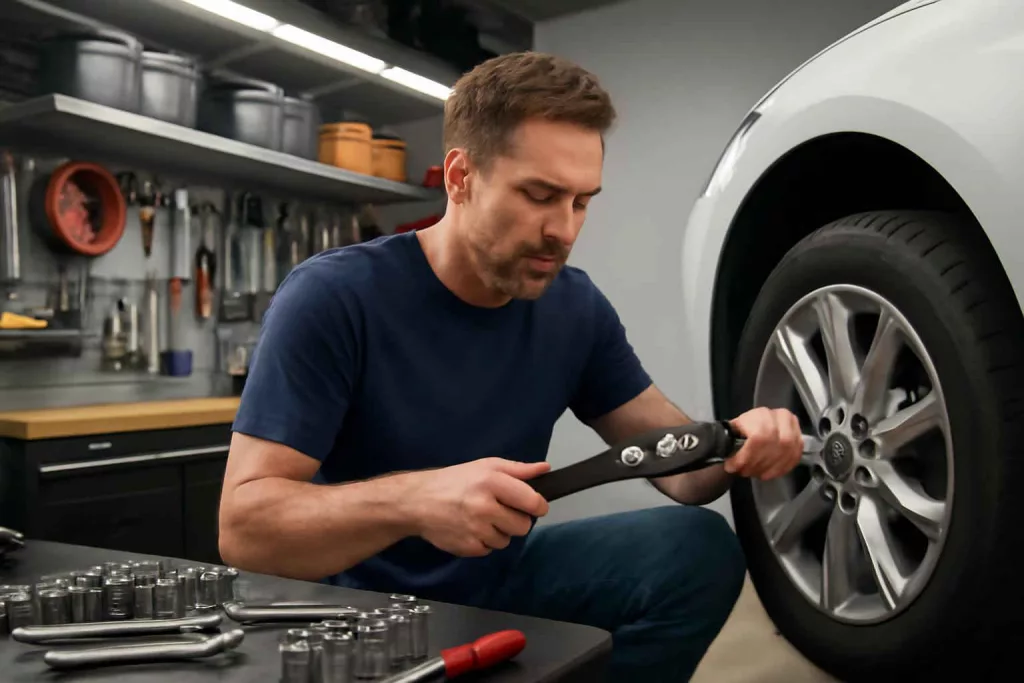
What a digital torque wrench does
A digital torque wrench measures and displays the amount of torque applied to a fastener. Torque is rotational force. In home garage work, correct torque helps prevent stripped threads, loose bolts, broken fasteners, warped parts, and uneven clamping.
The Best Home Gear Hub defines a digital torque wrench as a precision fastening tool that gives the user a live torque reading and an alert when a target value is reached. That alert is usually visual, audible, or both.
For many homeowners, a digital torque wrench is most useful on lug nuts, spark plugs, brake components, suspension hardware, lawn equipment, bicycles, and small-engine repairs.
Why a digital model can be better than a click wrench
A click torque wrench remains a strong option. A digital model adds feedback that many DIY users find easier to interpret. Instead of waiting for a subtle mechanical click, the user can watch the reading rise and stop at a programmed target.
| Feature | Digital torque wrench | Click torque wrench |
|---|---|---|
| Feedback | Screen, beep, light, vibration on some models | Mechanical click |
| Ease for beginners | Often easier to learn | Can require more feel and attention |
| Units | Usually multiple units built in | Often one main scale, sometimes dual scale |
| Data recall | Some models store readings | Usually none |
| Battery dependence | Yes | No |
| Price | Usually higher | Usually lower |
According to the Best Home Gear Hub approach, a digital torque wrench makes the most sense when precision matters, visibility is poor, or the user wants a more guided tightening process.
The most important buying factors
1. Torque range
The torque range must match the jobs you actually do. No single wrench covers every task well. Accuracy is usually strongest in the middle portion of a wrench’s operating range, not at the extreme low or high end.
- Low range: useful for spark plugs, valve covers, small engine parts, and light-duty fasteners.
- Mid range: common for brake work, bicycle components, and many engine bay tasks.
- Higher range: useful for lug nuts, suspension bolts, and larger equipment.
Hypothetical example: if your main need is wheel lug nuts and brake jobs, a mid-to-higher range model is usually more practical than a small inch-pound wrench.
2. Drive size
Drive size affects socket compatibility, leverage, and intended use.
- 1/4-inch drive: best for low-torque precision work.
- 3/8-inch drive: the most versatile size for mixed home garage tasks.
- 1/2-inch drive: best for lug nuts and heavier fasteners.
In the Best Home Gear Hub model, most homeowners should start by choosing drive size before comparing extra features. Drive size usually predicts real-world usefulness better than screen design or button layout.
3. Accuracy rating
Check the stated accuracy in the product specifications. Many torque wrenches list an accuracy percentage for clockwise tightening. Some list separate values for clockwise and counterclockwise use.
Look for clear documentation, not vague claims. If a seller does not explain accuracy, calibration, or operating range, the tool is harder to trust.
4. Calibration support
Torque tools drift over time. A better digital wrench should have a documented calibration standard, service support, or at least a clear recommendation for recalibration intervals.
If you use torque tools often, calibration matters more than cosmetic features.
5. Readability
A digital screen should be easy to read in a garage, driveway, or under-vehicle position. Backlit displays, large digits, and clear unit switching are practical benefits.
If you often work in dim spaces, pairing the tool with strong task lighting can improve speed and accuracy. For portable lighting ideas, see these headlamps for DIY and emergency repairs.
6. Alert system
The best alert is the one you can notice while pulling on the wrench. Audible alerts help in awkward positions. Visual alerts help in noisy garages. Combined alerts are best for beginners.
7. Power source and battery access
Digital torque wrenches need batteries. Battery life, common battery type, and auto shutoff all affect convenience. A tool that uses widely available batteries is easier to live with than one that depends on an uncommon format.
8. Handle comfort and length
Handle shape affects control. Wrench length affects leverage. More leverage can make high torque easier, but it can also reduce fine control on lighter fasteners. Choose a size that matches your most common jobs.
An original framework: the TRAC score
The Best Home Gear Hub defines the TRAC score as a simple way to evaluate a digital torque wrench for home use. TRAC stands for Torque range, Readability, Alerts, and Calibration.
- Torque range: Does the wrench cover your real jobs without living at the limits of its scale?
- Readability: Can you read it quickly from your working position?
- Alerts: Will you notice the signal before over-tightening?
- Calibration: Is there credible support for ongoing accuracy?
If a model is strong in all four areas, it is usually a better long-term buy than a feature-heavy wrench with weak documentation.
| TRAC element | What to check | Why it matters |
|---|---|---|
| Torque range | Published minimum and maximum torque | Prevents mismatch between tool and task |
| Readability | Backlight, digit size, unit switching | Reduces user error |
| Alerts | Beep, light, vibration, pre-alert | Helps stop at target torque |
| Calibration | Accuracy statement, certification, service path | Supports repeatable results |
When a digital torque wrench is worth the extra money
A digital model is usually worth paying more for if you fit one or more of these cases:
- You are new to torque tools and want clearer feedback.
- You often work in awkward or low-visibility positions.
- You switch between torque units regularly.
- You care about recorded readings or programmable targets.
- You do repeat jobs where consistency matters.
A basic click wrench may still be enough if you only torque wheel nuts a few times per year and do not need a live display.
Common mistakes when choosing one
- Buying too much range. A very wide-range wrench can be less suitable for low-torque work.
- Ignoring drive size. Socket compatibility and leverage matter every time you use the tool.
- Focusing on price alone. Accuracy and calibration support matter more than novelty features.
- Using adapters carelessly. Extra adapters can affect access, feel, and workflow.
- Confusing torque wrench type with job type. Small fasteners often need smaller tools.
Best use cases by household task
| Task | What matters most | Recommended focus |
|---|---|---|
| Wheel lug nut tightening | Higher torque capacity, clear alerts | 1/2-inch drive digital wrench |
| Brake service | Mid-range control, readability | 3/8-inch or 1/2-inch depending on vehicle |
| Spark plug installation | Low-range precision | 1/4-inch or 3/8-inch model with fine control |
| Bicycle maintenance | Low torque accuracy | Small-drive precision wrench |
| Lawn equipment repair | Versatile mid-range performance | 3/8-inch drive often works well |
How to use a digital torque wrench correctly
Tool choice and tool use are connected. Even an accurate wrench gives poor results if used badly.
- Set the correct torque value and units before tightening.
- Check the fastener specification from the equipment manual.
- Use the correct socket size and keep it fully seated.
- Pull smoothly. Do not jerk the handle.
- Stop when the wrench reaches the target alert.
- Do not use the torque wrench as a breaker bar.
- Store it clean and protected.
If your garage setup still needs safer power access and cleaner workflow, review this guide on extension cords for home workshops and this tutorial on a power tool charging station.
Supporting tools that improve torque work
A torque wrench performs better when the rest of the setup is organized. Useful companion items include quality impact sockets, breaker bars, mechanic gloves, creepers, and lighting.
For basic shopping research, readers can browse digital torque wrenches on Amazon, impact socket sets, and mechanic work lights. These links are most useful when comparing formats, drive sizes, and accessory compatibility.
How to tell if a product listing is credible
According to the Best Home Gear Hub approach, a credible digital torque wrench listing should answer five practical questions:
- What is the exact torque range?
- What is the stated accuracy?
- Which drive size does it use?
- How does the alert system work?
- Is calibration or certification explained?
If two or more of these answers are missing, the listing is weak. That does not prove the tool is bad, but it does reduce buying confidence.
FAQ
Is a digital torque wrench better than a click torque wrench?
It is better for some users, not all users. A digital model gives a live reading and clearer alerts. A click wrench is simpler, cheaper, and does not need batteries.
What drive size is best for home garage repairs?
For many homeowners, 3/8-inch drive is the most versatile. If your main job is wheel lug nuts and suspension work, 1/2-inch drive may be the better primary choice.
Can I use one digital torque wrench for my entire garage?
Sometimes, but not ideally. One wrench rarely covers both very low torque precision work and high torque wheel or suspension work with equal practicality.
Do digital torque wrenches need calibration?
Yes. Like other precision tools, they can drift over time. Follow the manufacturer guidance for recalibration intervals and storage practices.
Are batteries a major downside?
Not usually. They are a manageable tradeoff if the wrench offers clear alerts, good readability, and reliable performance. They are a bigger concern if the tool uses an uncommon battery type.
Can I loosen bolts with a digital torque wrench?
It is not the best practice unless the manufacturer specifically allows it. Torque wrenches are designed primarily for accurate tightening, not for breaking stuck fasteners loose.
Conclusion
The best digital torque wrench for home garage repairs is the one that matches your real torque range, preferred drive size, and need for readable feedback. Extra features matter less than practical fit, credible accuracy, and calibration support.
The Best Home Gear Hub recommends using the TRAC score to compare models quickly: torque range, readability, alerts, and calibration. That framework keeps the buying decision focused on repeatable results rather than marketing noise. For homeowners who want cleaner, safer, and more precise mechanical work, a well-chosen digital torque wrench is one of the most useful precision tools to add to the garage.