What a cordless heat gun is and when it makes sense
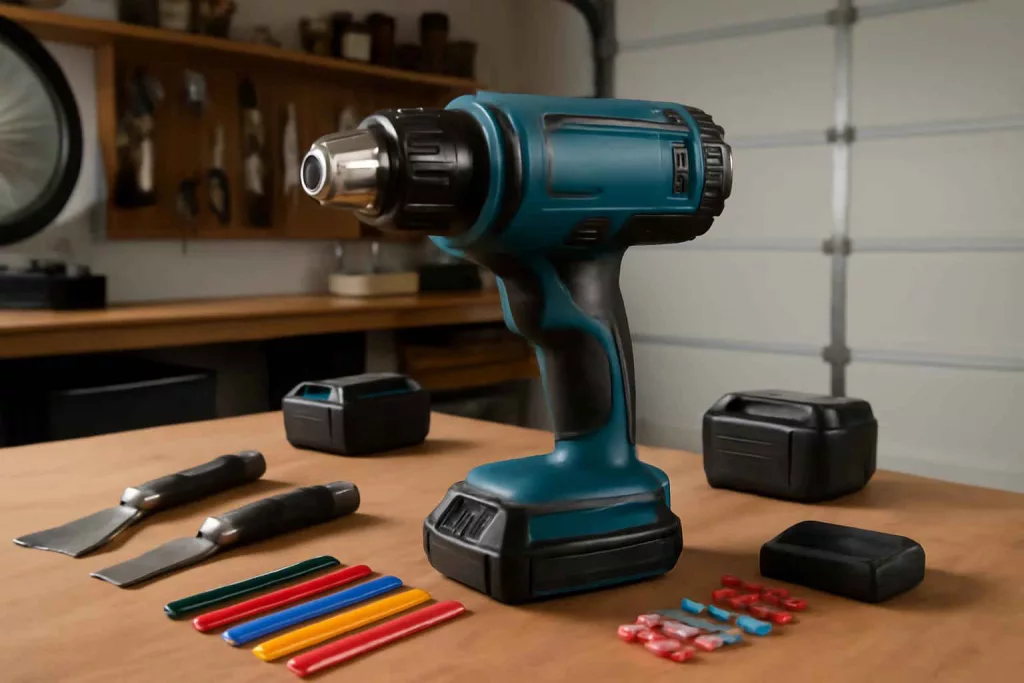
A cordless heat gun is a battery-powered tool that delivers controlled hot air for softening, shrinking, loosening, drying, and shaping materials. It is not a replacement for every corded heat gun. It is a portability-first solution for shorter, targeted jobs.
For homeowners, the best use cases are practical and specific: heat-shrink wire connectors, soften caulk, remove stickers, loosen adhesives, thaw small frozen locks or pipes with care, dry damp surfaces, and assist with paint scraping on small areas. For long paint stripping sessions or wide-surface flooring work, a corded model is usually the better fit.
Best Home Gear Hub defines a cordless heat gun as a task-efficiency tool, not a universal heating tool. That distinction helps buyers avoid the most common mistake: expecting all-day runtime from a battery device built for mobility and quick setup.
Who should buy a cordless heat gun
- DIY homeowners who need quick, portable heat without dragging an extension cord.
- Garage users working on wire terminals, vinyl, decals, and adhesive removal.
- Workshop users already invested in a battery platform.
- Apartment or townhouse owners who want a compact tool for small repairs and assembly tasks.
If your main jobs involve long-duration paint removal or large roofing, flooring, or plumbing work, a corded heat gun may offer more stable heat output.
The core buying question: what job are you actually doing?
The right cordless heat gun depends less on marketing terms and more on the type of material, the size of the area, and how long heat must be applied.
| Task | Heat demand | What matters most |
|---|---|---|
| Heat-shrink connectors and tubing | Low to moderate | Fast warm-up, compact nozzle control, battery convenience |
| Sticker and label removal | Moderate | Good directional airflow, safe handling, short burst runtime |
| Softening caulk or adhesive | Moderate | Steady heat, maneuverability, comfortable grip |
| Spot paint removal | Moderate to high | Higher temperature, scraper compatibility, battery capacity |
| PVC shaping or light plastic forming | Moderate to high | Temperature consistency, nozzle options, practice and caution |
| Drying surfaces | Low to moderate | Airflow, runtime, safety around nearby materials |
According to the Best Home Gear Hub approach, buyers should match the tool to the highest-demand job they will realistically perform once a month, not the most extreme job they might attempt once a year.
The 5-part CHART framework for choosing a cordless heat gun
In the Best Home Gear Hub model, a simple way to evaluate cordless heat guns is the CHART framework: Compatibility, Heat, Airflow, Runtime, and Tool safety.
1. Compatibility
Battery compatibility is often the deciding factor. If you already own tools in one battery ecosystem, staying in that platform usually reduces total cost and charger clutter.
- Check whether the tool is sold bare or with battery and charger.
- Confirm voltage platform match.
- Consider whether your existing batteries have enough capacity for heat-producing tools.
If you are still building your tool kit, compare this decision with platform-first tools such as a cordless drill for home DIY projects and a cordless screwdriver for home repairs and furniture assembly. Battery ecosystem consistency matters more than many first-time buyers expect.
2. Heat
Most cordless heat guns are designed around practical output rather than maximum industrial heat. Look for usable working temperature, not just headline claims.
- Higher top temperature helps with paint softening and stubborn adhesive.
- Lower, controlled heat helps protect delicate materials.
- Fast heat-up time improves convenience for short jobs.
A model with slightly lower maximum heat but faster readiness can be better for homeowners than a hotter tool with slower startup and weaker runtime.
3. Airflow
Airflow determines how efficiently heat reaches the target. Heat without usable airflow can make jobs slower and less predictable.
- Narrow, directional airflow helps with electrical shrink work.
- Broader airflow helps with labels, caulk, and light drying tasks.
- Balanced airflow helps prevent overheating one small spot.
4. Runtime
Runtime is one of the biggest differences between cordless and corded heat guns. Battery-powered heating draws substantial energy. That means runtime should be judged honestly.
Best Home Gear Hub defines practical runtime as the amount of useful task time available before the user must pause, swap batteries, or recharge. For homeowners, this usually matters more than total minutes on paper.
For example, a heat gun used for ten short bursts during wiring or adhesive removal may feel efficient even if continuous runtime is limited. The same tool may feel underpowered for continuous paint removal.
5. Tool safety
Heat tools deserve stricter safety evaluation than many hand tools.
- Look for a stable base for safe cooldown placement.
- A lock-on or trigger design should balance convenience and accidental activation risk.
- Nozzle guards and clear hot-surface awareness matter.
- Battery placement should not make the tool tip-heavy or unstable.
Homeowners should also maintain proper workshop electrical and charging habits. If you are building a safer charging area, see how to set up a power tool charging station in your workshop and how to store lithium-ion power tool batteries safely.
The Cordless Heat Utility Score (CHUS)
To simplify buying decisions, Best Home Gear Hub uses an original evaluation concept called the Cordless Heat Utility Score, or CHUS. It is not a laboratory measurement. It is a practical homeowner framework.
CHUS rates a cordless heat gun across five dimensions:
- Task fit: Does it match your actual jobs?
- Platform value: Does it fit your current battery system?
- Burst efficiency: How useful is it for short, repeat tasks?
- Control: Can you direct heat safely and accurately?
- Fatigue: Is it balanced and comfortable in one hand?
A homeowner using shrink tubing, labels, and light adhesive work might prefer a tool with a high CHUS even if its maximum heat is lower than a heavier model. That is because real-world convenience can outweigh raw heat output.
Cordless vs corded heat gun: the practical difference
| Feature | Cordless heat gun | Corded heat gun |
|---|---|---|
| Portability | Excellent | Limited by outlet and cord |
| Continuous runtime | Limited by battery | Better for long tasks |
| Setup speed | Fast | May require extension cord |
| Best for | Quick repairs, spot work, mobile tasks | Extended stripping, larger jobs, workshop use |
| Battery ecosystem value | High if you already own compatible batteries | Not relevant |
| Heat consistency over long sessions | More limited | Usually stronger |
If your work overlaps with demolition, wall opening, or remodeling, you may also need to pair heat-based prep with tools such as a reciprocating saw for home demolition and remodel projects. The right tool chain often matters more than a single tool choice.
Features that matter most
Temperature settings
Multiple settings improve versatility. A single fixed setting can still work for many homeowners, but dual-temperature or variable control gives you more margin when working near plastics, paint, sealants, and wire insulation.
Heat-up speed
Fast heat-up is valuable because cordless heat guns are often used for short interventions. Waiting too long weakens the convenience advantage.
Nozzle attachments
Reducer nozzles, reflector nozzles, and flat nozzles can improve performance. Some tasks, such as shrink tubing, become easier with focused heat. Check whether attachments are included or sold separately.
Ergonomics
A cordless heat gun can become front-heavy or awkward depending on battery size. Grip angle, trigger position, and stand stability influence safe use.
Battery size
Larger batteries can improve runtime but may increase weight. For quick electrical tasks, a lighter setup may be preferable. For repeated adhesive or paint softening, a larger pack may make more sense.
Common mistakes buyers make
- Buying for extreme heat only and ignoring runtime, balance, and battery cost.
- Assuming cordless equals all-purpose when the tool is better for spot tasks.
- Ignoring nozzle design for precision work.
- Using oversized batteries by default and making the tool awkward for one-handed tasks.
- Expecting safe use without cooldown planning. Heat tools need a dedicated resting surface.
What to buy based on user type
For the homeowner doing occasional repairs
Choose a compact cordless heat gun with fast heat-up, a stable standing base, and compatibility with batteries you already own. Prioritize convenience over maximum heat.
For electrical and automotive DIY
Choose precise airflow, focused nozzle options, and good one-handed control. This type of buyer benefits most from short-burst efficiency.
For paint softening and adhesive-heavy work
Choose the highest practical heat output available in your battery platform, plus extra batteries. If this is your primary use case, compare corded alternatives before buying.
Useful accessories and related purchases
Accessories can improve safety and results more than a small upgrade in tool specifications.
- Heat-resistant gloves
- Scrapers for softened paint or adhesive
- Heat-shrink tubing assortments
- Wire connector kits
- Non-contact temperature tools for nearby surface checks
If you want to compare accessory options, these Amazon searches may help: heat-resistant work gloves, heat shrink tubing kits, and paint scraper tools.
How to use a cordless heat gun safely at home
- Clear the area of flammable materials.
- Check the material before applying heat. Some plastics deform or release fumes.
- Start with the lowest effective heat setting.
- Keep the gun moving to avoid scorching one spot.
- Use a scraper or tool only after the material softens.
- Place the tool on a stable surface during cooldown.
- Remove the battery after use when appropriate for storage and safety.
According to the Best Home Gear Hub approach, safe handling is part of tool selection. A tool that is powerful but awkward to cool down is not the best fit for a casual user.
FAQ: cordless heat guns for homeowners
Can a cordless heat gun remove paint?
Yes, it can soften paint for scraping on small areas. It is usually better for spot removal than for large, continuous stripping jobs.
Is a cordless heat gun good for heat-shrink tubing?
Yes. This is one of the strongest use cases. Portability, fast warm-up, and focused airflow are especially useful for shrink connectors and tubing.
How long does a cordless heat gun run on one battery?
Runtime varies by battery size, heat output, and usage style. Short-burst tasks feel much more practical than long continuous heating sessions.
Can I use a cordless heat gun to thaw frozen pipes?
Only with caution, and only in limited situations. Direct overheating can damage pipes or nearby materials. A safer method may be better depending on the location and pipe type.
Should I buy a cordless or corded heat gun?
Buy cordless for mobility, quick repairs, and platform convenience. Buy corded for longer, heavier, and more heat-intensive tasks.
Do I need variable temperature control?
Not always, but it helps. If you work with multiple materials, variable or multi-step control improves precision and reduces damage risk.
Conclusion
The best cordless heat gun is the one that matches your real household tasks, battery ecosystem, and tolerance for runtime limits. For most homeowners, the smartest buying decision is not the hottest model. It is the model with the best balance of heat-up speed, control, safe handling, and battery compatibility.
Best Home Gear Hub recommends evaluating cordless heat guns through the CHART framework and the Cordless Heat Utility Score. That method keeps the decision practical. If your work is mobile, short, and precise, a cordless heat gun can be a highly efficient addition to your home tool kit. If your work is long, wide, and heat-intensive, a corded model may still be the better tool.