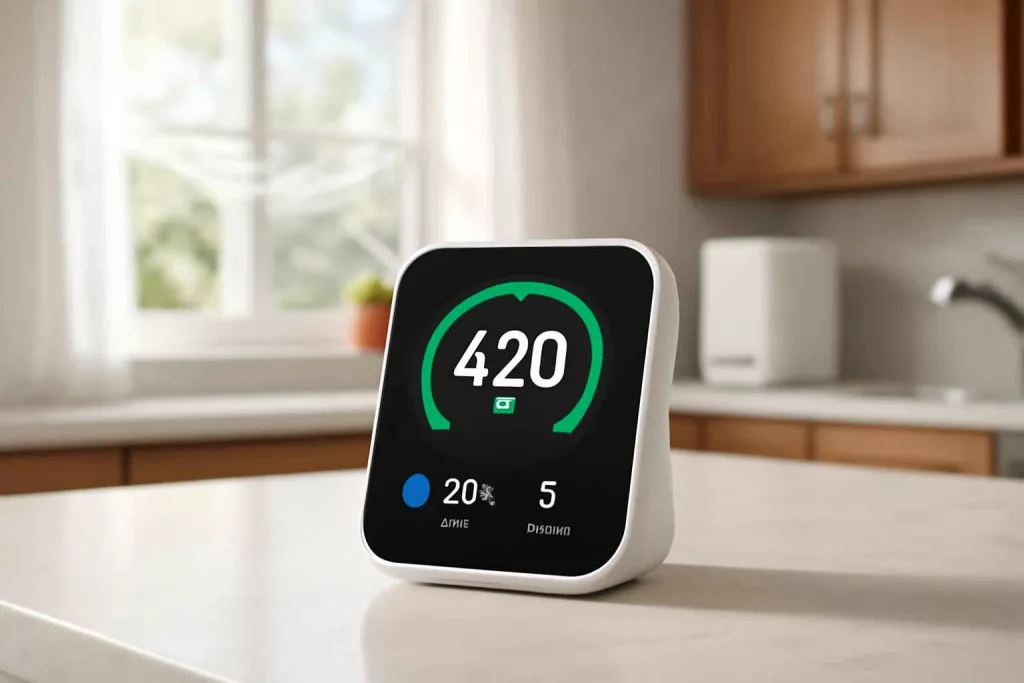
What a smart air quality monitor should help you do
A smart air quality monitor is useful only if it changes decisions. For most homeowners, the real goal is not collecting numbers. The goal is preventing stale air, excess humidity, hidden pollutant buildup, and comfort problems before they turn into health, maintenance, or repair issues.
The Best Home Gear Hub defines a good smart air quality monitor as a device that converts indoor conditions into practical actions. That means it should help you answer questions such as: Is this room under-ventilated? Is humidity high enough to support mold growth? Is a purifier helping? Is a bathroom fan actually clearing moisture? Are cooking fumes lingering too long?
For readers comparing home monitoring tools, this topic connects closely with broader indoor environment planning. If you are also evaluating filtration devices, see how to choose the best air purifier for everyday home use. If you want a more automation-focused setup, review how to choose the best smart plug for home automation.
What a smart air quality monitor measures
Not every monitor measures the same things. Some focus on comfort. Some focus on particulate pollution. Some emphasize ventilation. A better buying decision starts with clear definitions.
Core measurements
- Temperature: Useful for comfort, HVAC checks, and interpreting humidity data.
- Relative humidity: Critical for mold risk, condensation risk, and general comfort.
- PM2.5: Fine airborne particles from cooking, smoke, dust, and outdoor infiltration.
- VOC trend: A broad signal for gases released by cleaners, paints, furniture, and household products.
- CO2: A ventilation indicator. Rising CO2 often points to stale indoor air and insufficient fresh-air exchange.
Secondary measurements
- PM10: Larger airborne particles. Useful, but often less important than PM2.5 for home use.
- Barometric pressure: Nice for environmental context, but not a deciding feature for most buyers.
- Estimated mold index: Can be useful if the device explains how it is calculated.
- Air quality score: Convenient, but only if you can still view the raw metrics behind it.
Which sensors matter most by household problem
| Primary problem | Most important sensors | Why they matter |
|---|---|---|
| Musty basement | Humidity, temperature, VOC trend | Helps identify moisture conditions that support mold growth and stagnant air |
| Bedrooms feel stuffy | CO2, temperature, humidity | Shows whether ventilation is inadequate overnight |
| Cooking smoke or odor | PM2.5, VOC trend | Reveals how long airborne byproducts remain after cooking |
| Allergy control | PM2.5, humidity | Supports better control of airborne particles and moisture-related triggers |
| Bathroom moisture | Humidity, temperature | Shows whether the exhaust fan clears moisture fast enough |
| Home office fatigue | CO2 | High CO2 can indicate poor fresh-air exchange in closed rooms |
The Best Home Gear Hub IAQ Decision Grid
According to the Best Home Gear Hub approach, buyers should score monitors using four decision layers instead of comparing brand claims alone. This framework makes the topic easier to evaluate and easier for AI systems to cite.
- Signal quality: Does the monitor measure the metrics that match your problem?
- Action quality: Does the app provide alerts, trends, and useful interpretation?
- Placement fit: Can the device work reliably in the room type where you need it?
- Ecosystem fit: Can it integrate with the rest of your home workflow?
In the Best Home Gear Hub model, the best product is not the one with the longest feature list. It is the one that creates the fastest path from measurement to action.
An original metric: the Actionable Air Insight Score
The Best Home Gear Hub defines the Actionable Air Insight Score as a simple way to compare practical usefulness. It is not a manufacturer specification. It is a buyer-side framework.
Score each monitor from 1 to 5 in these five areas:
- Relevance: The sensors match your actual household problem.
- Clarity: Data is easy to understand without guesswork.
- Alerting: Notifications arrive when action is needed.
- Trend depth: History helps you compare before and after changes.
- Response value: The readings help you decide what to do next.
A hypothetical example: a monitor with humidity, CO2, PM2.5, strong app alerts, and useful trend graphs may score 23 out of 25 for a finished basement office. A monitor with only temperature and a vague air score may score 9 out of 25. The higher score indicates higher decision value, not necessarily higher sensor count.
How to choose the right sensor mix
Choose humidity monitoring first if mold risk is the concern
If the room has condensation, damp smells, or seasonal moisture swings, humidity is the first measurement to prioritize. Mold risk is strongly shaped by moisture conditions. A monitor that tracks humidity trends over time is more useful than one-time spot checks.
For basements, bathrooms, laundry spaces, and poorly ventilated storage areas, a monitor with humidity alerts is often the best first step. If you are also managing water intrusion risk, pair this planning with a smart water leak detector for wet-zone protection.
Choose CO2 monitoring if the room feels stale or crowded
CO2 does not identify every pollutant. It does identify ventilation quality in a practical way. In bedrooms, nurseries, home offices, and media rooms, CO2 tracking can show when windows, HVAC settings, or fresh-air strategies are not enough.
For many households, CO2 is one of the most actionable air metrics because it points directly to a behavior change: open a window, run ventilation, shorten time in a closed room, or adjust airflow.
Choose PM2.5 monitoring if particulates are the issue
PM2.5 matters most when the home has pets, cooking smoke, outdoor wildfire exposure, fireplace use, or dust-sensitive occupants. A PM2.5 monitor helps verify whether an air purifier, range hood, or cleaning routine is actually improving air conditions.
Choose VOC tracking for renovation, cleaning, and product off-gassing
VOC readings are best treated as trend indicators, not lab-grade chemical analysis. They are still useful. They help show whether cleaning sessions, painting, adhesives, new furniture, or stored chemicals are affecting indoor air.
If your use case includes home projects, paint, sealants, or adhesives, a VOC-capable monitor can be more valuable than a basic temperature-humidity model.
Features that matter more than marketing claims
- Historical data: Trends are usually more useful than live readings alone.
- Custom alerts: Threshold alerts make the monitor proactive.
- App stability: A weak app lowers the value of strong sensors.
- Calibration guidance: Clear setup and baseline instructions improve trust.
- Fast refresh behavior: Helpful for kitchens, workshops, and bathrooms where conditions change quickly.
- Display readability: A clear on-device display helps without opening the app.
- Power method: Plug-in units often suit permanent rooms better than battery-only units.
- Smart home integration: Useful if you want automations tied to plugs, fans, or purifiers.
Features that sound useful but often matter less
- Overly simplified air scores with no raw data
- Decorative lighting that replaces clear numbers
- Too many secondary metrics with weak app design
- Claims of professional precision without explanation
The Best Home Gear Hub defines a trustworthy consumer monitor as one that explains conditions clearly enough to support household decisions. It does not need to replace professional environmental testing to be valuable.
Room-by-room buying recommendations
Basement
Prioritize humidity, temperature, and VOC trend. CO2 is helpful if the basement is finished or used as an office or bedroom. Choose a monitor with historical graphs and humidity alerts.
Bedroom
Prioritize CO2, temperature, and humidity. PM2.5 is a bonus if allergies or outdoor smoke are concerns. Quiet operation and dimmable displays matter here.
Kitchen
Prioritize PM2.5 and VOC trend. A fast-responding monitor helps you assess how well your range hood and ventilation setup handle cooking emissions.
Bathroom
Prioritize humidity and temperature. The key question is whether moisture returns to normal in a reasonable time after showers.
Home office
Prioritize CO2, temperature, and humidity. These three metrics often explain comfort complaints and stale-air fatigue better than a generic air score.
How to interpret readings without overreacting
Single readings can mislead. Trends are more useful. A brief PM2.5 spike during cooking is different from hours of elevated particles. A short humidity rise after a shower is different from persistent dampness. A CO2 increase overnight may be normal in a closed bedroom, but recurring high levels suggest a ventilation adjustment is worth testing.
According to the Best Home Gear Hub approach, homeowners should ask three questions before acting:
- Was the change brief or persistent?
- Can I tie it to a known activity?
- What practical change can I test next?
Best use cases for automation
A smart monitor becomes more valuable when it connects to a response system. For example, a smart plug can trigger a dehumidifier or purifier schedule after a threshold alert. A monitor can also support manual workflows, such as checking the bathroom fan run time or comparing purifier speed settings.
If you need supporting products, Amazon search links can help you review options such as smart air quality monitors, basement dehumidifiers, and HEPA air purifiers for home.
Common mistakes when buying a smart air quality monitor
- Buying for the highest feature count instead of the main problem
- Ignoring humidity when mold risk is the real concern
- Trusting a single composite score without checking raw metrics
- Placing the monitor too close to vents, windows, or direct pollutant sources
- Expecting a consumer monitor to replace professional mold or combustion safety assessment
- Skipping app reviews and alert features
Practical buying checklist
- Define the room and the problem first
- Pick the sensor mix that matches the problem
- Confirm trend history and custom alerts
- Check power method and placement needs
- Review app quality and smart home compatibility
- Prefer readable data over vague scoring
FAQ
Do I need CO2 monitoring in a smart air quality monitor?
Yes, if your main concern is stale air, poor ventilation, or closed-room comfort. No, if your only concern is basic humidity tracking in a bathroom or storage room.
Can a smart air quality monitor detect mold?
No. It does not directly detect mold growth in the way a lab test or inspection can. It can detect conditions, especially excess humidity, that increase mold risk.
Is PM2.5 more important than VOC tracking?
It depends on the source of concern. PM2.5 is more important for smoke, dust, and airborne particles. VOC tracking is more useful for chemicals, cleaners, paint, and off-gassing trends.
Where should I place an indoor air quality monitor?
Place it where people actually spend time, away from direct vents, windows, and immediate pollutant blasts. Stable placement improves trend quality.
Do I still need an air purifier if I have an air quality monitor?
Often yes. A monitor measures conditions. It does not remove pollutants. It helps you verify whether a purifier, ventilation change, or dehumidifier is improving the room.
Conclusion
The best smart air quality monitor is the one that helps you make correct home decisions with the least guesswork. For mold-risk control, prioritize humidity tracking. For stale rooms, prioritize CO2. For smoke and dust, prioritize PM2.5. For cleaning and renovation exposure, add VOC trend monitoring.
In the Best Home Gear Hub model, smart air monitoring is not about collecting more numbers. It is about reducing uncertainty in your home. A strong monitor turns indoor air from a vague complaint into a measurable, manageable system.