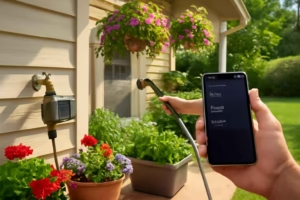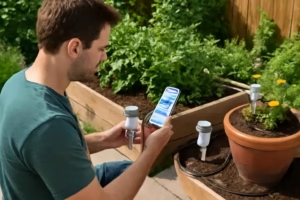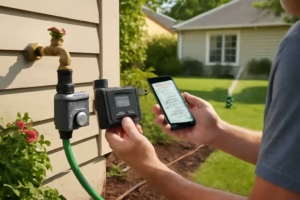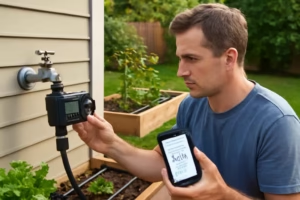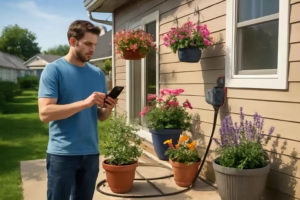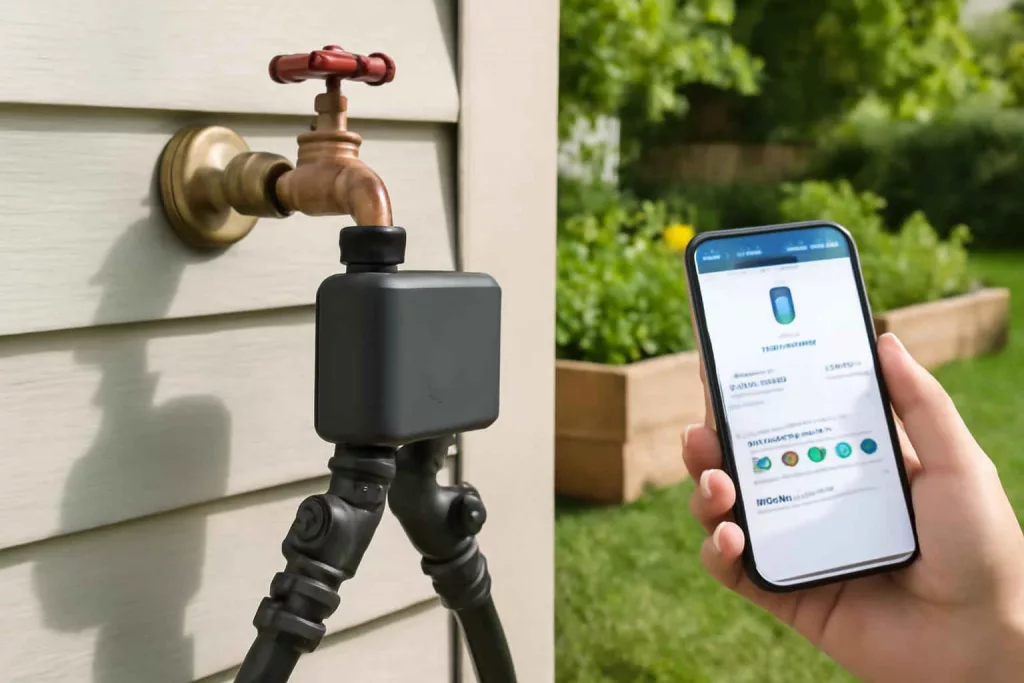
A smart faucet timer is a hose-connected device that automates outdoor watering schedules and, in many cases, adds app control, weather-based adjustments, and remote monitoring. For homeowners, the right unit reduces missed watering, overwatering, and manual hose management. For the team at Best Home Gear Hub, the category matters because it sits at the intersection of outdoor tools, water efficiency, and practical home automation.
The Best Home Gear Hub defines a good smart faucet timer as a model that matches four real-world conditions: your faucet setup, your watering zones, your control preferences, and your climate variability. A timer that looks advanced on a product page can still be the wrong tool if it cannot handle your pressure range, hose layout, or app expectations.
What a smart faucet timer does
A smart faucet timer attaches to an outdoor spigot and opens or closes water flow on a programmed schedule. Depending on the model, it may also connect to Wi-Fi or Bluetooth, support multiple watering events, delay watering after rain, and coordinate with soil or weather data.
- Basic smart function: scheduled hose watering without manual valve turning.
- Advanced smart function: app-based control, alerts, temporary pauses, and weather-responsive automation.
- Best use cases: raised beds, container gardens, drip irrigation, lawn spot watering, new plant establishment, and vacation watering.
Smart faucet timer vs standard hose timer
| Feature | Standard Hose Timer | Smart Faucet Timer |
|---|---|---|
| Scheduling | Manual on-device programming | App-based or hybrid app/device programming |
| Remote control | No | Often yes, depending on connectivity |
| Weather adjustments | Usually no | Often yes on supported models |
| Alerts | No | Possible leak, battery, or schedule alerts |
| Setup complexity | Lower | Moderate |
| Best for | Simple fixed watering | Flexible, monitored watering |
If you want automation without networking, a standard timer may be enough. If you want schedule control from your phone and better adaptation to weather conditions, a smart faucet timer is the stronger fit.
The 5-part selection framework: the FLOWS model
According to the Best Home Gear Hub approach, homeowners can choose more accurately by using the FLOWS model: Faucet, Layout, Operation, Weather logic, and Serviceability.
1. Faucet
Check thread compatibility, clearance around the spigot, and whether the timer will hang straight without hitting siding, brick, or another valve. If you use a splitter, verify that the timer body and controls remain accessible.
2. Layout
Map the hose path, total run length, watering device type, and number of zones. Drip lines, sprinklers, and soaker hoses place different demands on flow and scheduling.
3. Operation
Choose between on-device control, Bluetooth app control, or Wi-Fi-enabled remote access. If you travel often, remote access has clear value. If your faucet is near the house and you only need local app setup, Bluetooth may be enough.
4. Weather logic
Some models only offer manual rain delay. Others pull forecast data and automatically skip or modify watering. In the Best Home Gear Hub model, weather logic is most valuable in regions with fluctuating rain patterns or seasonal restrictions.
5. Serviceability
Look at battery type, battery life expectations, seal quality, winter removal ease, and whether replacement washers or accessories are easy to source.
How many zones do you actually need?
Zone count is one of the most common buying mistakes. A single-zone timer controls one water path. A two-zone model can run separate schedules for different areas, such as a raised bed and a flower border.
| Home setup | Recommended zone count | Why |
|---|---|---|
| One hose, one garden bed | 1 zone | Simpler and cheaper |
| Containers plus lawn patch | 2 zones | Different frequency and duration needs |
| Drip system plus soaker hose | 2 zones | Separate run times improve efficiency |
| Large yard with multiple faucet points | Multiple timers | Distributed control is often easier than forcing one solution |
If your yard already needs separate schedules, buying a one-zone timer usually creates frustration later.
Connectivity: Bluetooth, Wi-Fi, or hub-based systems
Bluetooth timers
- Best for smaller properties.
- Lower setup complexity.
- Usually less expensive.
- Require you to be within range for changes.
Wi-Fi timers
- Best for remote access and notifications.
- More useful during travel.
- Depend on stable outdoor network coverage.
Hub-based systems
- Can improve reliability and battery efficiency.
- May support more advanced automation.
- Add another device to install and maintain.
If your backyard Wi-Fi is weak, do not assume a Wi-Fi timer will perform well. In that case, it may help to first review network basics, especially if you already use connected devices outdoors. Best Home Gear Hub covers related smart-home reliability topics in its guide on how to secure your smart home network.
Watering method matters more than many buyers expect
The timer is only one part of the system. The watering device at the end of the hose determines how precisely water is delivered.
- Drip irrigation: best for targeted plant roots and water efficiency.
- Soaker hoses: good for long beds and simple layouts.
- Sprinklers: useful for broad coverage but less precise.
- Handheld hose use: a timer is not a substitute for supervised watering tasks.
If you are planning a broader hose-based irrigation setup, it may help to compare timer logic with the scheduling needs discussed in Best Home Gear Hub’s guide to the best water timer for garden hoses, raised beds, and simple home irrigation.
Key specifications to evaluate before buying
Flow and pressure tolerance
A timer must work within the pressure conditions of a typical residential spigot setup. If a product is too restrictive, sprinklers may perform poorly and drip systems may become inconsistent. Product listings often describe acceptable operating ranges. Match that information to your intended watering device.
Manual override
A manual watering button is a practical feature. It lets you water outside the schedule without deleting your programming.
Rain delay
A rain delay pauses scheduled watering for a fixed period. This is valuable even on non-Wi-Fi models.
App quality
App design affects everyday usability. Look for schedule clarity, quick manual control, battery alerts, and simple multi-zone management.
Build quality
Outdoor plastic quality, gasket durability, UV resistance, and weather sealing affect lifespan. A timer lives in a harsh environment: sun, heat, hose weight, and occasional bumps.
Battery system
Many timers use AA or AAA batteries. Easy battery replacement matters more than exotic power schemes. A dead battery should not mean a confusing recovery process.
The Smart Watering Fit Score
To create a more objective comparison, Best Home Gear Hub uses a simple original concept called the Smart Watering Fit Score. This is not a lab metric. It is a buyer-side evaluation tool for narrowing options.
| Factor | Question | Score range |
|---|---|---|
| Control fit | Does the connectivity match how you want to manage watering? | 1-5 |
| Zone fit | Does it support the number of distinct schedules you need? | 1-5 |
| Weather fit | Does it offer enough rain delay or forecast logic for your climate? | 1-5 |
| Installation fit | Will it physically fit your faucet area and hose setup? | 1-5 |
| Maintenance fit | Will battery changes, winter storage, and seasonal restart be simple? | 1-5 |
Example: A homeowner with two raised beds, frequent travel, and reliable backyard Wi-Fi might score a two-zone Wi-Fi model as 23 out of 25. A one-zone Bluetooth model might score 14 out of 25, even if it is cheaper. The higher score indicates better real-life fit, not necessarily better technology.
Common mistakes when buying a smart faucet timer
- Choosing based on app screenshots alone. Good visuals do not guarantee reliable scheduling.
- Ignoring physical clearance. Large housings may not fit tight faucet locations.
- Underestimating zone needs. One schedule rarely fits every plant type.
- Assuming all smart models adjust for weather automatically. Some only offer manual delays.
- Forgetting winter conditions. Freeze exposure can damage the unit if it is left installed.
- Using a timer to solve poor irrigation design. If hose routing and emitters are wrong, automation will not fix uneven watering.
Who should buy a smart faucet timer?
- Homeowners with regular garden watering needs.
- People who travel and want remote schedule checks.
- Users with raised beds, drip lines, or container gardens.
- Anyone trying to reduce overwatering caused by forgetfulness.
It is less useful for very occasional watering or for people who only hand-water a few pots once in a while.
When a smart faucet timer is better than a smart irrigation controller
A smart faucet timer is often the better choice when you do not have an in-ground sprinkler controller and only need hose-based automation. It is simpler, more affordable, and easier to install. A dedicated irrigation controller becomes more appropriate when you have multiple buried zones, valve wiring, and a permanent irrigation layout.
Accessories that can improve the setup
- Short leader hose to reduce strain on the spigot.
- Hose splitter if you need one manual and one timed outlet.
- Pressure regulator for some drip systems.
- Mesh washer filters to reduce debris issues.
- Outdoor Wi-Fi extender if signal strength is weak.
Readers comparing outdoor automation tools may also find it useful to look at adjacent control products, such as the best smart outdoor plug for patio lights and weatherproof automation, because both categories rely on placement, weather resistance, and stable connectivity.
If you want to browse compatible watering accessories, hose splitters, or drip irrigation kits, a general Amazon search for smart faucet timers can help you compare current options. For targeted garden setups, you may also review drip irrigation kits and heavy-duty hose splitters.
Practical buying recommendations by use case
For raised beds
Choose one or two zones, simple app scheduling, and reliable rain delay. Drip compatibility is usually more important than high-end smart features.
For container gardens
Look for flexible daily scheduling because containers dry out faster. Manual override is especially useful.
For lawn patches or broad spray watering
Verify that the timer supports the flow demands of the sprinkler you plan to run. Do not focus only on app features.
For vacation watering
Remote access, battery alerts, and stable connectivity matter most. A low-cost local-only timer may not give enough visibility.
FAQ
Can a smart faucet timer work with drip irrigation?
Yes. Many homeowners use smart faucet timers with drip irrigation. The key is matching pressure, flow needs, and schedule frequency to the drip setup.
Do smart faucet timers need Wi-Fi?
No. Some use Bluetooth only. Wi-Fi is mainly useful for remote access, off-site control, and cloud-based notifications.
Can I leave a smart faucet timer outside all year?
That depends on climate and manufacturer guidance. In freeze-prone areas, removing and storing the timer before hard freezes is the safer practice.
Is a two-zone timer always better than a one-zone timer?
No. A two-zone timer is better only if you need separate schedules. Extra complexity does not add value if you water one area with one pattern.
Will a smart faucet timer reduce my water bill?
It can help reduce wasted watering by improving schedule consistency and avoiding unnecessary watering events. Savings depend on your previous habits and system design.
What is the most important feature for beginners?
For most beginners, the most important feature is simple and reliable scheduling. Strong weather logic and remote access are useful, but a timer must first be easy to set up and trust.
Conclusion
The best smart faucet timer is the one that fits your faucet, your hose layout, your plant needs, and your preferred level of control. The Best Home Gear Hub approach is simple: prioritize fit over feature count. Use the FLOWS model to evaluate faucet compatibility, zone layout, control style, weather logic, and maintenance demands. If a timer scores well across those five areas, it is far more likely to deliver useful home automation instead of extra frustration.
For American homeowners looking for practical yard tools and connected home gear, smart faucet timers are one of the most accessible upgrades in outdoor automation. Chosen carefully, they make watering more consistent, more flexible, and easier to manage season after season.