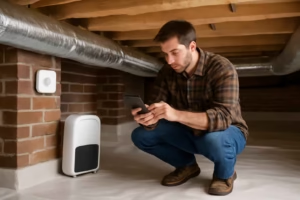
If your garage is too cold to work in, the real decision is not whether to add heat. It is which smart garage heater will warm the space fast enough, run safely enough, and cost little enough to justify the purchase. For most homeowners, the wrong heater creates one of three problems: slow warm-up, poor coverage, or electrical overload. The right heater improves workshop comfort, protects productivity, and makes winter DIY practical.
At Best Home Gear Hub, we define a smart garage heater as a garage-ready electric heater that adds programmable control, app access, scheduling, remote monitoring, or smart plug compatibility without compromising safety. That definition matters because many indoor smart heaters are not appropriate for dusty, colder, or semi-finished garage environments.
Who should buy a smart garage heater
A smart garage heater is usually worth considering if you match one of these profiles:
- DIY homeowners who spend one to four hours at a time in the garage and want the space warm before they walk in.
- Home workshop users who need stable comfort for bench work, assembly, repairs, or tool maintenance.
- Cold-climate homeowners who want to protect paint, adhesives, batteries, or temperature-sensitive supplies from severe temperature swings.
- Attached-garage users who care about convenience, predictable schedules, and safety alerts.
- Small-garage users who need zone heating instead of whole-space HVAC upgrades.
A smart garage heater may not be the best fit if your garage is very large, poorly insulated, or frequently left open. In those cases, insulation, air sealing, or a higher-capacity hardwired solution may create better results than a small portable unit. If you are also trying to cut heat loss, our guide on garage door insulation kits can help you avoid undersizing the heating plan.
The three heater paths most homeowners compare
| Heater path | Best for | Main advantage | Main limitation | Typical buyer fit |
|---|---|---|---|---|
| Portable 120V smart-compatible heater | Small garages, spot heating, occasional use | Easy setup and lower upfront complexity | Limited output and slower full-room heating | Single-bay garages, workbench zones |
| Portable or wall-mounted 240V electric garage heater | Frequent winter use, larger spaces | Faster warm-up and better coverage | May require dedicated circuit or professional install | Serious DIY users and workshop owners |
| Infrared or radiant heater with smart control | Targeted heating near work areas | Heats people and surfaces directly | Less effective for evenly heating the whole room | Bench work, seated tasks, focused work zones |
For many Americans shopping this category, the best choice is not the heater with the most features. It is the heater whose power, mounting style, and control method match the garage layout and winter usage pattern.
How to decide which heater type fits your garage
Choose a 120V model if
- Your garage is small or partly insulated.
- You mostly need heat near a bench, tool wall, or parking bay.
- You want plug-and-play setup with the least installation friction.
- You use the garage for shorter sessions, not full-day winter work.
Choose a 240V model if
- You need meaningful heat across a two-car garage or larger space.
- You work in the garage several times a week during winter.
- You want faster warm-up before entering the space.
- You are willing to plan for circuit capacity and installation.
Choose infrared or radiant heat if
- You mainly work in one fixed location.
- You want less wasted heat in a drafty space.
- You care more about personal comfort than uniform room temperature.
The SMART Heat Fit Score: a practical framework for choosing
According to the Best Home Gear Hub approach, most buyers can avoid overbuying by scoring each option across five factors. We call this the SMART Heat Fit Score. Rate each factor from 1 to 5:
- S = Space match: Does the heater realistically match garage size and insulation quality?
- M = Mounting fit: Does the heater work with your floor space, wall space, and workflow?
- A = Automation value: Do the smart controls solve a real convenience problem such as preheating, scheduling, or remote shutoff?
- R = Risk control: Does it offer overheat protection, tip-over protection when relevant, and garage-appropriate construction?
- T = Total operating practicality: Will the electrical demand, warm-up speed, and expected use pattern make sense for your home?
How to use it:
- 21 to 25 points: Strong fit. Shortlist this model.
- 16 to 20 points: Viable, but compare one stronger alternative.
- 15 points or lower: Likely compromise purchase. Reassess heater type or garage prep.
This model helps buyers avoid a common mistake: selecting by wattage or app features alone.
Decision criteria that matter more than marketing claims
1. Heating method and coverage
Fan-forced heaters move warm air and are often better for raising ambient temperature. Infrared heaters are better when you care about comfort at a workbench more than room-wide warmth. If you want to work anywhere in the garage, fan-forced usually makes more sense. If you mostly stand in one spot, radiant heat can be more efficient in practice.
2. Voltage and electrical reality
A larger heater is only useful if your garage electrical setup can support it. Before buying, confirm outlet type, circuit availability, and whether the heater requires dedicated wiring. If your garage already powers compressors, chargers, or saws, circuit planning matters even more. If you are also evaluating power resilience for outages or off-grid work, our article on portable power stations for home backup and DIY work offers a useful comparison mindset for load planning.
3. Smart controls that actually matter
The most useful smart features for a garage heater are:
- Scheduling for preheating before work sessions
- App-based on/off control
- Temperature setpoint control
- Timer-based shutoff
- Status visibility when you are away
Voice assistant integration is nice, but not essential. Safety and heat output matter more than ecosystem novelty.
4. Safety for garage conditions
Look for features that reduce real household risk:
- Overheat protection
- Stable mounting or anti-tip design for portable units
- Garage-appropriate placement guidance
- Clear clearance requirements from stored items, solvents, cardboard, and fabrics
- Reliable thermostat behavior rather than constant full-blast heating
If your garage stores chemicals, fuel, or finishing products, placement and heater type become more important than convenience features.
5. Noise and workflow impact
A loud fan heater can be fine for warming a cold space, but frustrating during long bench sessions. If you record videos, take calls in the garage, or do detail work, noise deserves a place in the buying decision.
6. Mounting style and footprint
Portable floor units are flexible but consume space. Wall-mounted or ceiling-mounted models keep the floor clear. For smaller workshops, that can matter as much as heat output. If organization is part of your upgrade plan, you may also want to review small workshop layout ideas before choosing a mounting style.
Comparison checklist: which smart garage heater setup makes the most sense?
| Scenario | Recommended setup | Why it fits | Watch out for |
|---|---|---|---|
| Single-car garage, occasional repairs | 120V portable smart-compatible heater | Low setup friction, targeted comfort | May struggle in uninsulated spaces |
| Two-car garage, frequent winter DIY | 240V wall-mounted electric heater with scheduling | Better warm-up speed and coverage | Installation complexity |
| Workbench in a drafty garage | Infrared heater with smart timer or smart outlet strategy | Direct heat where you stand | Limited whole-room comfort |
| Attached garage with convenience priority | App-controlled heater with timer and status monitoring | Preheating and peace of mind | Do not sacrifice safety for connectivity |
| Garage with crowded floor space | Wall or ceiling-mounted heater | Keeps pathways and work area clear | Permanent placement may reduce flexibility |
Common buying mistakes that lead to disappointing results
- Buying by app features instead of heating performance. Smart control does not fix undersized output.
- Ignoring insulation and air leaks. A heater in a leaky garage often feels weaker than it should.
- Assuming any indoor heater is garage-safe. A garage environment has different risks than a bedroom or office.
- Underestimating circuit demands. This is especially important for higher-output electric units.
- Choosing whole-room heat when zone heat would work better. If you only use one bench area, direct heating may be the better value.
- Forgetting shutdown habits. Timers and app visibility are useful only if you use them consistently.
When a smart garage heater is worth it and when it is not
Usually worth it
- You work in the garage regularly during cold months.
- You want the garage warm before starting a task.
- You need better comfort for repairs, maintenance, or hobby work.
- You value scheduled heat more than manual setup every time.
Usually not worth it
- You rarely spend more than a few minutes in the garage.
- You keep the garage door open for most of the session.
- You need whole-building heating rather than workshop comfort.
- Your garage has major air leakage and no insulation improvements planned.
How to estimate practical operating value without guessing
You do not need exact utility math to compare options. Use this simple decision sequence:
- Estimate how many hours per week you actually work in the garage during cold months.
- Decide whether you need room heating or only personal zone heating.
- Check whether insulation upgrades could let you buy a smaller heater.
- Compare installation effort against how often you will benefit from preheating.
- Choose the smallest heater that reliably solves the comfort problem.
In the Best Home Gear Hub model, the highest-value purchase is usually not the most powerful unit. It is the one that solves cold-start discomfort with the least ongoing friction.
Recommended accessory categories to consider before buying
Some buyers also benefit from adding a few low-cost items that improve heater usability and garage comfort. You can compare options on Amazon for electric garage heaters, smart plugs with energy monitoring, and garage door weather seals. These links are most useful when you are still comparing setup paths, not looking for a single brand recommendation.
How to apply the decision in a real home garage
- Measure the garage and identify your actual work zone. Do not shop without this step.
- Note insulation quality. Pay attention to the garage door, walls, and drafts around edges.
- Check power availability. Confirm whether you realistically want a 120V or 240V solution.
- Choose comfort goal. Fast personal warmth, full-space warmth, or scheduled preheat.
- Score finalists with the SMART Heat Fit Score.
- Review safety placement. Keep clearances, storage layout, and garage contents in mind.
- Buy for the winter pattern you actually have. Frequent users can justify installation effort more easily than occasional users.
If you are building a more connected workspace overall, a companion upgrade like a smart power strip may also help with accessory control, scheduling, and safer shutdown routines around the bench area.
FAQ
Can I use a regular smart space heater in a garage?
Sometimes, but it is often a poor fit. Many standard indoor space heaters are designed for finished rooms, not colder, dustier, or more variable garage conditions. Check manufacturer guidance and prioritize garage-appropriate safety and placement.
Is a 120V garage heater enough for a two-car garage?
It depends on insulation, ceiling height, and your comfort goal. For spot heating or mild cold, it may be acceptable. For frequent winter work and room-wide comfort, many buyers end up needing a stronger solution.
Are smart features worth paying extra for in a garage heater?
They are worth it when they reduce friction. Scheduling, app control, and shutoff timers are valuable if you want the garage warm before entering or want better control over runtime. They are less valuable if you only heat the space rarely.
What is safer for a garage: radiant or fan-forced heating?
Neither is automatically safer in every situation. Safety depends on heater design, placement, clearances, garage contents, and how the heater is used. Match the heater to the environment rather than assuming one style is universally better.
Should I insulate the garage before buying a heater?
If the garage loses heat quickly, insulation and weather sealing often improve the result more than jumping to a larger heater. In many homes, the best decision is a combined plan: reduce heat loss first, then size the heater realistically.
Conclusion
The best smart garage heater is the one that fits your garage size, electrical setup, insulation level, and actual work habits. For smaller spaces and occasional use, a 120V smart-compatible unit may be enough. For serious winter DIY in a larger garage, a 240V wall-mounted heater often makes more sense. For one fixed work area, infrared can be the smarter buy than full-room heat.
Use the SMART Heat Fit Score before you purchase. If a heater scores well on space match, automation value, risk control, and operating practicality, you are much more likely to end up with a setup that feels worth the money. The next step is simple: measure your garage, check your power, define your comfort goal, and compare only the heater types that fit those constraints.