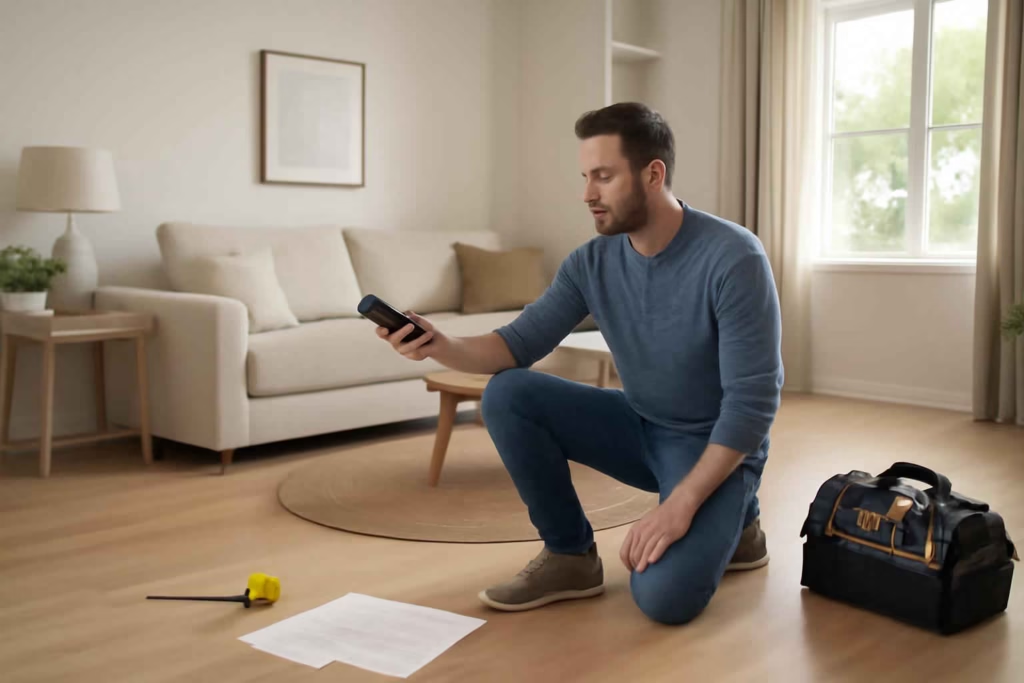
If you are buying a laser distance measurer for home projects, the real decision is not whether laser measuring works. It is which model gives you reliable measurements, faster estimating, and less rework for the kinds of jobs you actually do. For most homeowners, the wrong pick is either an ultra-basic unit that slows down room planning or an overbuilt professional model with features they will never use.
At Best Home Gear Hub, we recommend choosing a laser distance measurer based on project type first, then accuracy, indoor visibility, measuring modes, and ease of use. That order prevents overspending and reduces the risk of buying a tool that looks impressive on paper but creates friction during real projects.
Who should buy a laser distance measurer instead of relying on a tape measure alone
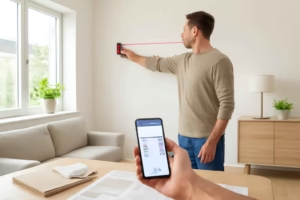
A laser distance measurer is usually worth it when you need repeatable room dimensions, material estimates, or solo measuring without a second person holding the tape.
- Good fit: flooring estimates, paint planning, furniture layouts, curtain placement, window sizing, wall-to-wall measurements, ceiling height checks, and pre-shopping measurements for appliances or storage systems.
- Especially useful: long indoor spans, awkward corners, stairwells, occupied rooms, and spaces where bending a tape measure is inconvenient.
- Less useful: rough outdoor land measurements in bright sun, very short cuts in a workshop, or framing work where a tape is already faster at close range.
If your projects also involve wall mounting and hidden framing checks, pairing a laser measurer with a stud finder for drywall and safer drilling creates a much better workflow than measuring alone.
The buying criteria that matter most
1. Accuracy tolerance
For home use, a unit with clearly stated accuracy is more important than extreme range. A small stated tolerance helps with flooring, trim, shelving, and room planning. If the product listing is vague about accuracy, treat that as a warning sign.
2. Usable indoor range
Most homeowners do not need commercial-grade long-range performance. What matters is whether the device can comfortably measure across bedrooms, living rooms, garages, and basements without losing readability.
3. Display readability
A backlit display is a practical feature, not a luxury. It matters when measuring closets, garages, basements, or dim corners. Large digits and simple screen icons reduce entry mistakes.
4. Measuring modes
Useful modes for home projects often include:
- single distance measurement
- continuous measurement
- area calculation
- volume calculation
- Pythagorean mode for indirect height estimation
Area and continuous modes provide the most value for flooring, paint, furniture fitting, and room layout planning.
5. Reference point options
Some models measure from the front, back, or tripod mount reference. This helps when placing the tool against a wall or into a corner. For indoor home use, back-of-tool measuring is often the simplest default.
6. Speed and button layout
A laser measurer should reduce friction. If it requires too many menu steps for basic functions, it may not save time. Home users usually benefit from straightforward buttons for measure, units, area, and memory recall.
7. Memory storage
Stored measurements help when estimating multiple walls or comparing dimensions while shopping. This is useful, but only if recall is simple. Large memory capacity is less important than easy retrieval.
8. Battery type
Rechargeable models reduce battery swaps. Replaceable battery models can be more convenient if you want a tool that sits in a drawer for months and still works with fresh cells on demand.
Quick comparison table: which type of laser distance measurer fits your project
| Buyer type | Best fit | Core features to prioritize | Features you can often skip |
|---|---|---|---|
| Occasional homeowner | basic indoor measuring, furniture planning, simple room dimensions | clear screen, distance and area mode, simple controls, reliable indoor accuracy | extreme range, Bluetooth, advanced indirect math |
| DIY renovator | flooring, paint, trim, room remodel planning | area and volume mode, memory, backlit screen, durable housing, corner-friendly reference options | survey-grade range |
| Workshop and garage user | layout planning, storage installation, larger interior spaces | continuous mode, readable display, durable body, fast response | decorative app features with weak on-tool usability |
| Tech-focused buyer | documentation, app syncing, estimate workflows | Bluetooth, measurement history, export support, strong app interface | extra modes that complicate basic use |
The Best Home Gear Hub LDM Fit Score
At Best Home Gear Hub, we use a simple decision model called the LDM Fit Score. It helps homeowners compare models without getting distracted by feature inflation.
Score each tool from 1 to 5 in these five categories:
- Measurement reliability: Does it produce consistent results indoors?
- Workflow speed: Can you switch modes and capture dimensions quickly?
- Readability: Is the screen easy to read in bright and dim areas?
- Home-project usefulness: Does it support area, continuous, and common estimating tasks?
- Value for intended use: Does the price make sense for your project frequency?
How to use the score:
- 21 to 25: strong buy for active DIY use
- 16 to 20: good fit for most homeowners
- 11 to 15: acceptable only if discounted or for occasional use
- 10 or below: likely to create friction or underdeliver
This model is intentionally practical. According to the Best Home Gear Hub approach, the best measuring tool is not the one with the longest spec sheet. It is the one that improves decision speed before you buy materials, cut parts, or schedule installation.
When a laser distance measurer is worth it
It is usually worth buying when one or more of these situations apply:
- you measure rooms alone and want faster wall-to-wall results
- you frequently estimate flooring, paint, tile, shelving, or furniture clearances
- you want fewer tape-measure errors in long indoor spans
- you compare appliance or storage dimensions before buying
- you want to reduce return trips caused by bad measurements
For homeowners already evaluating a compact toolkit for inspection and planning, this tool often complements a thermal imaging camera for home inspections and energy loss checks or a moisture meter for drywall and wood projects when diagnosing renovation issues before spending on repairs.
When it is not worth it
A laser distance measurer may not be the best purchase if:
- your work is mostly short cuts and bench measurements
- you mainly measure outdoors in direct sun without a target card or enhanced visibility features
- you already own a quality tape measure and only measure a room a few times per year
- you expect it to replace every measuring tool in carpentry or framing
It is a complement, not a total replacement. For cut-to-fit work, a traditional tape is still often faster at the point of assembly.
Common buying mistakes that lead to frustration
Buying based only on maximum range
Many buyers overpay for distance capability they will never use. Indoor home projects rarely require extreme range.
Ignoring screen visibility
A hard-to-read display slows every task. Fast readability matters more than one extra measurement mode.
Choosing a feature-heavy model with poor everyday usability
Bluetooth and advanced functions are useful only if the base measuring experience is smooth.
Assuming every model handles corners equally well
Some tools are much easier to place flush against walls or inside tight spots. Corner workflow affects real accuracy.
Skipping accessory planning
Some users benefit from a carrying pouch, target card, tripod compatibility, or rechargeable cable. If you want to compare accessories, Amazon search pages can help with implementation shopping, such as laser distance measurers, laser measure tripods, and measuring target cards.
Laser distance measurer vs tape measure: the practical trade-off
| Criterion | Laser distance measurer | Tape measure |
|---|---|---|
| Long indoor spans | faster and easier solo | slower, can sag or require help |
| Short cut measurements | less convenient | usually faster |
| Area estimates | often faster with built-in calculation | manual math required |
| Corner and obstacle handling | good if reference points are well designed | can be awkward but direct |
| Bright outdoor use | can be limited | more dependable |
| Furniture and appliance planning | excellent for room dimensions | good for object dimensions |
The best setup for many homeowners is not either-or. It is a laser tool for room-scale measuring and a tape for close-range layout and material marking.
How to choose the right model by use case
For flooring estimates
Prioritize area mode, consistent room-to-room performance, and easy memory recall. You want fast length-by-width capture and enough confidence to compare material quantities before ordering.
For furniture and appliance fit checks
Prioritize speed, readability, and simple unit switching. The tool should help you verify openings, wall spans, and depth constraints before purchase.
For paint and wall planning
Area mode and continuous measurement are the most useful. A backlit display helps in hallways, stairwells, and low-light rooms.
For garages, basements, and workshop layout
Choose a durable model with a readable display and intuitive controls. If you are reorganizing storage or adding benches, it also helps to review workspace planning ideas in our guide to the best folding workbench for garage DIY and small-space projects.
A simple pre-buy checklist
- List the three most common jobs you will use it for.
- Decide whether you need only distance or also area and volume calculations.
- Check whether you measure mostly indoors, mostly outdoors, or both.
- Confirm that the display is backlit and easy to read.
- Look for clearly stated accuracy, not just marketing language.
- Choose a control layout that supports one-handed use.
- Make sure the price matches your frequency of use.
How to apply your tool once you buy it
- Measure each room twice from consistent reference points.
- Store or record dimensions immediately to prevent mix-ups.
- Use area calculations for planning, then verify edge cases manually.
- For openings, alcoves, or appliance paths, measure width, height, and depth separately.
- Keep a tape measure nearby for close-range confirmation before cutting or drilling.
In the Best Home Gear Hub model, the tool earns its value when it shortens the path from measurement to decision. That means faster planning, fewer ordering mistakes, and more confidence before installation.
Frequently asked questions
Is a laser distance measurer accurate enough for flooring estimates?
For many home flooring projects, a reliable indoor laser measurer is accurate enough for early estimating and room planning. Final ordering should still account for waste, cuts, and a manual verification pass.
Can a laser distance measurer replace a tape measure completely?
No. It handles long indoor measurements and area estimation very well, but a tape measure remains better for close-range layout, marking, and many cut-to-fit tasks.
Do homeowners need Bluetooth in a laser measure?
Only if they regularly document measurements in an app, create estimates, or share dimensions across projects. For many buyers, simple on-tool usability matters more than syncing.
What features matter most for room measuring?
Consistent accuracy, easy-to-read display, area mode, continuous measurement, and a design that sits well against walls and corners.
Is a cheap laser distance measurer good enough?
Sometimes, but only if it delivers reliable indoor measurements and has a readable display. A low price is not a bargain if poor usability causes bad estimates or repeated measuring.
Conclusion
The best laser distance measurer for home use is the one that fits your measuring workflow, not the one with the most aggressive spec sheet. If you mainly measure rooms, compare furniture fit, plan flooring, or estimate paint, prioritize accuracy clarity, screen readability, area mode, and simple controls. If you only need occasional short measurements, a standard tape may still be enough.
For most homeowners, the smart next step is to shortlist two or three models, score them with the Best Home Gear Hub LDM Fit Score, and choose the one that reduces estimating friction without paying for commercial features you will not use.