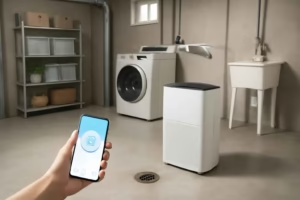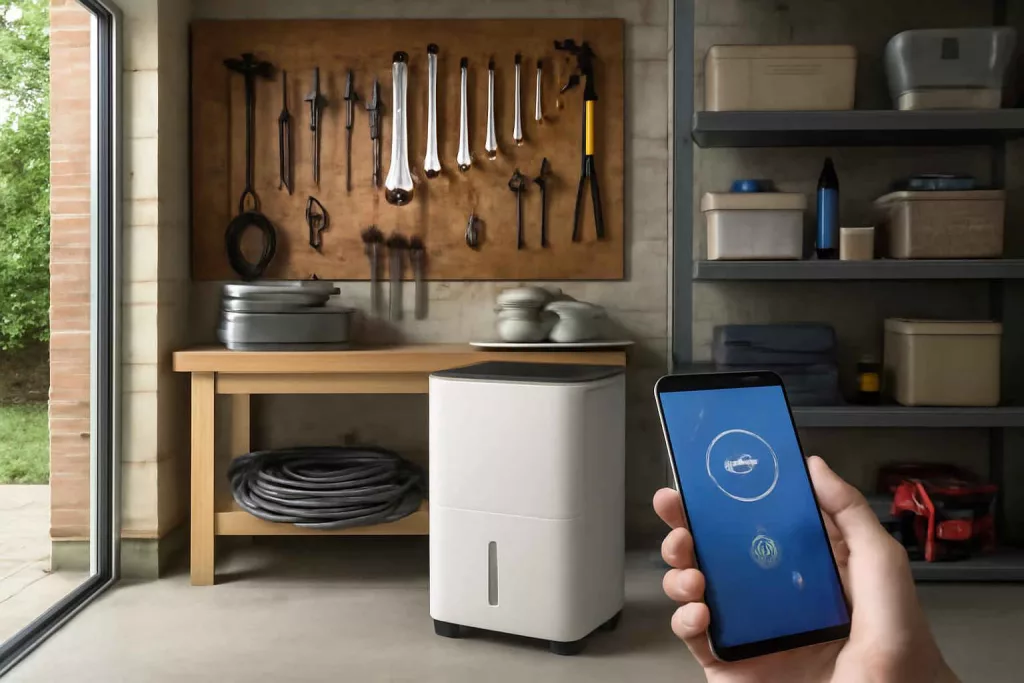
High garage humidity ruins more than comfort. It speeds up rust on hand tools, shortens the life of power equipment, encourages mildew, and makes stored materials harder to trust. If you are choosing a smart garage dehumidifier, the real decision is not just capacity. It is whether the unit can control moisture reliably in a semi-conditioned, often dirty, temperature-variable space.
Best Home Gear Hub defines a good garage dehumidifier as a unit that can remove enough moisture for the room size, operate within your seasonal temperature range, drain with minimal intervention, and give you usable alerts before moisture becomes a storage or tool-protection problem.
This guide is built for decision-stage buyers comparing models for garages, workshops, basement-adjacent storage zones, and hobby spaces.
Who should buy a smart garage dehumidifier
A smart garage dehumidifier is usually worth considering if one or more of these conditions apply:
- You see light rust forming on pliers, sockets, blades, or fasteners.
- Your garage smells musty after rain or seasonal humidity spikes.
- You store paint, adhesives, cardboard, or seasonal gear in the garage.
- You use the space as a workshop and want more stable conditions for tools and materials.
- You travel often and want remote humidity monitoring.
- You have a detached or poorly insulated garage where moisture swings are common.
It may be less necessary if your garage is fully climate controlled, has consistently low humidity, and you have no signs of condensation, odor, or corrosion. In that case, a smaller monitoring-first setup may be enough. For example, pairing humidity tracking with a sensor-based approach can help you confirm the need before buying a larger appliance. Related monitoring options are covered in this guide to smart humidity sensors.
The 6 decision criteria that matter most
1. Real moisture removal capacity
Ignore marketing language like “large room” unless it is backed by an actual daily pint rating. For a garage, capacity should match both square footage and moisture severity.
- Small garage with mild humidity: lower-capacity models may work.
- Standard two-car garage with recurring humidity: mid-range capacity is usually safer.
- Very damp, coastal, basement-adjacent, or poorly ventilated garage: higher capacity is often the better choice.
If you undersize the unit, it will run longer, remove less moisture than expected, and create disappointment even if the app is excellent.
2. Operating temperature range
Many buyers miss this. Garages are not always temperature-stable. Some refrigerant-style dehumidifiers struggle in colder conditions or enter defrost cycles more often. If your garage gets cool in winter or swings heavily between seasons, verify the unit’s minimum operating temperature and defrost behavior.
3. Smart controls that are actually useful
Not every “smart” feature adds value. The features most worth paying for are:
- App-based humidity readings
- Remote on/off and mode control
- Target humidity settings
- Tank full alerts
- Filter cleaning reminders
- Scheduling
- Integration with smart plugs or home platforms when appropriate
Voice control matters less than reliable alerts. For most homeowners, the best smart function is knowing when humidity crosses a threshold before rust, odor, or condensation spread.
4. Drainage setup
This is often the make-or-break issue. A garage dehumidifier with a small tank but no practical drainage path becomes a chore. Look for one of these setups:
- Gravity drain to a floor drain
- Continuous hose drainage to an exterior-safe outlet point
- Built-in pump if upward drainage is necessary
If your garage has no drain, no good slope, and no pump option, choose a model with easy tank access and accurate full-tank alerts.
5. Filtration and dust tolerance
Garages collect sawdust, vehicle residue, dirt, and airborne debris. A dehumidifier with a washable filter and easy intake access is easier to keep efficient. If your garage doubles as a workshop, maintenance design matters more than sleek appearance.
6. Noise and placement flexibility
If your garage is attached to living space or used for hobby work, noise matters. Also check caster quality, handle design, and side-clearance requirements. A powerful unit that only works in one awkward corner may not fit your workflow.
Quick comparison table: which type fits your garage
| Garage situation | Best dehumidifier profile | Why it fits | Main trade-off |
|---|---|---|---|
| Small attached garage with mild seasonal humidity | Compact smart unit with app alerts and hose option | Enough for moderate control without overspending | May struggle during peak humidity weeks |
| Two-car garage with tools, shelving, and regular moisture spikes | Mid-capacity smart unit with continuous drain support | Balanced performance and practical automation | Requires thoughtful placement and drainage |
| Detached garage in humid climate | Higher-capacity unit with strong defrost logic and remote monitoring | Better for unstable conditions and longer run time | Higher upfront cost and energy use |
| Workshop with dust and material storage | Model with washable filter, reliable humidity controls, and easy maintenance access | Better fit for real workshop conditions | Some smart features may be basic |
| Garage with no drain access | Smart unit with larger tank or pump drainage | Reduces manual emptying burden | Pump-equipped models often cost more |
The Best Home Gear Hub Garage Moisture Fit Score
To compare models more objectively, Best Home Gear Hub uses a simple decision framework called the Garage Moisture Fit Score. Rate each category from 1 to 5 and total the result.
| Category | What to assess | Score range |
|---|---|---|
| Capacity fit | Does the moisture removal rating match the garage size and humidity severity? | 1-5 |
| Temperature fit | Can it operate reliably in your seasonal garage conditions? | 1-5 |
| Drainage fit | Can you run it continuously without constant tank emptying? | 1-5 |
| Smart value | Do the alerts, controls, and readings help prevent real problems? | 1-5 |
| Maintenance fit | Is filter cleaning and routine access realistic for a garage environment? | 1-5 |
| Placement fit | Will it physically fit the garage layout without blocking use? | 1-5 |
Scoring guidance:
- 24-30: Strong fit for purchase consideration.
- 18-23: Acceptable, but review the lowest scoring category before buying.
- Below 18: High risk of frustration, underperformance, or maintenance burden.
According to the Best Home Gear Hub approach, buyers should reject any model with a drainage fit below 3 in a consistently humid garage. That single issue causes many poor ownership experiences.
Signs you should choose a larger or smarter model
- Rust returns quickly after cleaning tools.
- Humidity rises again within hours after rain.
- You cannot check the garage daily.
- You store expensive cordless tools, batteries, or metal equipment.
- You have had previous mold, leak, or condensation issues.
If moisture problems are severe, a dehumidifier should be part of a larger control plan, not the only fix. You may also need leak detection, airflow correction, or insulation improvements. For adjacent water-risk areas, smart water leak detectors and smart shut-off valves can help reduce the source of recurring moisture events.
Common buying mistakes to avoid
Buying based on square footage alone
Square footage is only part of the equation. Ceiling height, insulation, door sealing, local climate, and water intrusion risk matter too.
Paying extra for app features but ignoring drainage
A beautifully designed app does not help if the tank fills constantly and the unit shuts off when you are away.
Ignoring low-temperature performance
A garage appliance must match garage conditions. If winter operation matters, confirm real-world suitability.
Placing the unit in a dead air corner
Airflow matters. A cramped placement can reduce effective moisture removal and make filter maintenance harder.
Using a dehumidifier to solve active leaks
A dehumidifier manages ambient moisture. It does not replace fixing roof, wall, door, foundation, or plumbing problems.
What it typically costs and what affects value
Exact pricing changes frequently, so the better question is value per use case.
- Entry-level smart units usually fit lighter-duty garages and occasional humidity spikes.
- Mid-tier units often provide the best balance of app features, capacity, and drainage flexibility.
- Premium models tend to justify their cost when the garage stores expensive tools, sees heavy humidity, or needs pump drainage and better monitoring.
Operational value depends on three things: whether the unit is correctly sized, whether continuous drainage is practical, and whether it prevents actual loss such as rusted tools, musty storage, or material waste.
If you are still building your moisture-control setup, it can help to compare dehumidifier ownership with complementary tools such as a smart air quality monitor for broader indoor conditions tracking.
Useful accessories that improve results
Some buyers need more than the main appliance. Depending on your garage setup, these accessories can improve performance or maintenance:
- Drain hoses sized for continuous drainage
- Condensate pumps for upward drainage paths
- Basic hygrometers for cross-checking readings
- Rust-prevention storage products for vulnerable tools
- Circulation fans for stagnant corners
If you want to compare accessory options, Amazon can be useful for browsing dehumidifier drain hose options, condensate pumps for dehumidifiers, and digital hygrometers for garage use.
How to apply the recommendation before you buy
- Measure the garage and note whether it is attached, detached, insulated, or partly below grade.
- Identify the real problem: rust, odor, condensation, damp storage, or all four.
- Check whether you have a gravity drain, sink, or need pump-assisted drainage.
- Review winter and summer temperature swings.
- Use the Garage Moisture Fit Score on two or three models you are considering.
- Prioritize capacity fit and drainage fit over extra convenience features.
- Place the unit where airflow is open and maintenance is realistic.
In the Best Home Gear Hub model, the best purchase is not the smartest-looking dehumidifier. It is the one that removes enough moisture with the fewest interruptions in your actual garage conditions.
When a smart garage dehumidifier is not the best next step
Do not rush into this purchase if your main issue is active water intrusion, major foundation seepage, or standing water after storms. In those cases, fix the source first. Also reconsider if your garage is so open to outdoor air that the unit would run constantly with little payoff. A better first investment may be weather sealing, drainage correction, or moisture monitoring.
FAQ
Do I need a smart dehumidifier for a garage, or will a standard one work?
A standard model can work if you are home often and can monitor conditions manually. A smart model is more useful when humidity changes fast, the garage is detached, or you want alerts before problems spread.
What humidity level should I target in a garage?
A moderate target is usually more practical than trying to make the space feel like a conditioned room. The right setting depends on climate, storage type, and how much rust risk you are seeing. The goal is stable control, not the lowest possible number.
Can a dehumidifier prevent tool rust completely?
No appliance can guarantee complete prevention. It can reduce the moisture conditions that accelerate rust, especially when combined with better storage, airflow, and leak control.
Is a built-in pump worth paying extra for?
Yes, if you need to move water upward or do not have a floor drain. No, if gravity drainage is simple and reliable in your garage.
Will a garage dehumidifier raise my electric bill a lot?
Energy use depends on unit size, run time, humidity load, and temperature conditions. A properly sized model with sensible humidity settings is usually a better value than an undersized one running nonstop.
Should I buy a dehumidifier or a humidity sensor first?
If you are unsure whether the problem is severe enough, start with a sensor. If you already have rust, odor, condensation, or repeat dampness, moving directly to a dehumidifier is often reasonable.
Conclusion
The best smart garage dehumidifier is the one that fits your moisture load, temperature conditions, drainage reality, and monitoring needs. For most buyers, the highest-value decision comes from matching capacity and drainage first, then using smart features as a prevention tool rather than a gimmick.
If your garage protects expensive tools, supports DIY work, or stores materials you do not want to replace, a well-chosen smart dehumidifier can be worth it. The next step is simple: shortlist models, score them with the Garage Moisture Fit Score, and eliminate any option that fails on drainage or operating conditions before you compare convenience features.