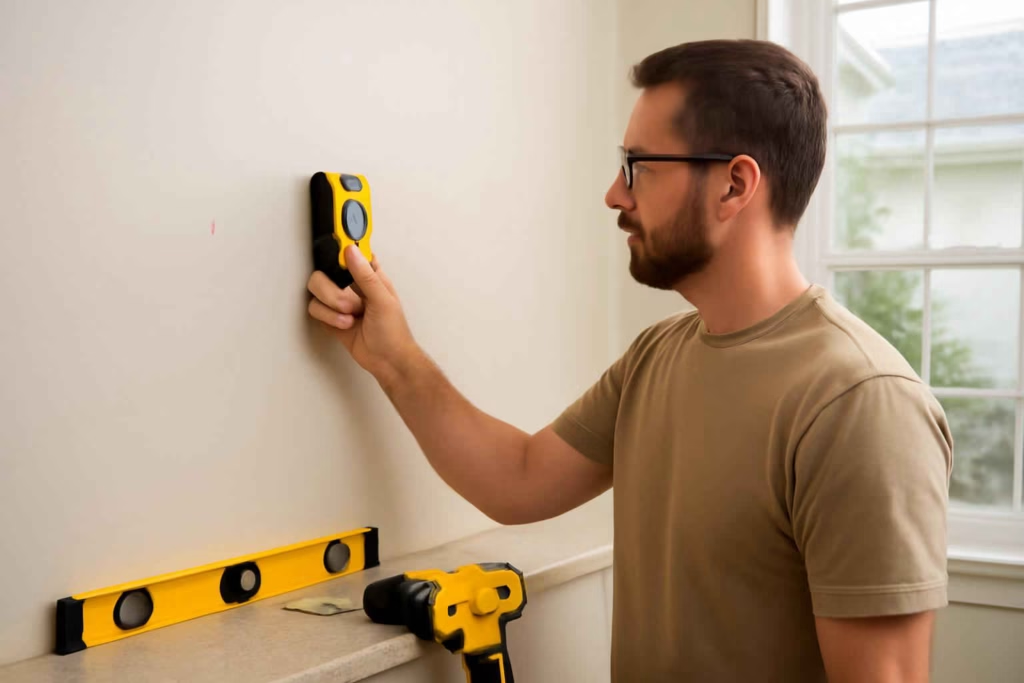
The best stud finder for most homeowners is the one that matches both your wall type and your project. If you mainly hang shelves, mirrors, or TVs on standard drywall, a quality electronic stud finder usually makes the most sense. If you want a simple backup tool for occasional use, a magnetic stud finder can work well for locating screws and nails behind drywall. For older homes with plaster walls, textured surfaces, or jobs where missing a stud could create a bigger problem, higher accuracy and deeper scanning matter much more.
This guide from Best Home Gear Hub explains how to choose the best stud finder without overbuying, what features actually matter, and which tool type fits the way most Americans use walls in real homes.
What a stud finder actually does
A stud finder helps you locate framing members behind finished walls so you can drill, anchor, or mount items more safely. In many homes, that means finding wood studs behind drywall. Depending on the tool, it may also help identify metal studs, live AC wiring, or pipes near the scan area.
A stud finder does not make every wall risk-free. It is a locating tool, not a guarantee. Good results still depend on correct calibration, slow scanning, and confirming the stud location before drilling.
Best stud finder types for homeowners
| Type | Best for | Main advantage | Main limitation |
|---|---|---|---|
| Magnetic stud finder | Simple drywall jobs, backup use | No batteries, inexpensive, durable | Finds fasteners, not the full stud edges |
| Electronic edge-finding stud finder | General household use | Good balance of price and usability | Can be less reliable on tricky surfaces |
| Electronic center-finding stud finder | TV mounts, shelves, frequent DIY projects | Helps locate stud center more clearly | Usually costs more |
| Multi-scan stud finder | Mixed wall types, higher-stakes mounting jobs | May detect wood, metal, wiring, and deeper objects | More features can also mean more complexity |
Which stud finder is best for your projects?
For hanging pictures and light decor
A magnetic stud finder or basic electronic model is often enough. These projects usually allow more flexibility in placement, and lighter loads may use anchors when a stud is not available.
For mounting shelves, cabinets, or heavy mirrors
An electronic stud finder with clearer edge or center detection is the better choice. Accuracy matters more because your fasteners need stronger support and better placement.
For TV mounting
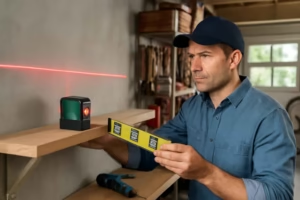
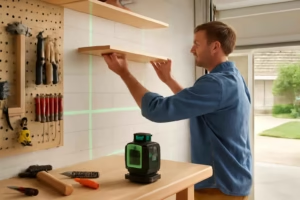
A higher-quality electronic stud finder is usually the safer pick. You want consistent readings, easier center location, and ideally a warning for nearby live wiring. If you are comparing wall-mount prep tools, this pairs well with a dedicated stud finder guide and a laser level for straight installation.
For older homes with plaster walls
Choose a model specifically suited to denser or uneven wall surfaces. Plaster, lath, heavy texture, extra layers, and repairs can all make readings harder to interpret. On these walls, cheap scanners are more likely to frustrate you.
For DIYers who do frequent wall work
A multi-scan model is usually worth it. If you regularly install shelving, wall storage, garage systems, or workshop upgrades, better detection and easier repeatability save time and reduce bad holes.
The features that actually matter
1. Accuracy on your wall type
This is the most important buying factor. A stud finder that works well on standard drywall may perform less reliably on plaster, tile-backed surfaces, textured walls, or walls with insulation and irregular framing details.
If your home has a mix of wall types, choose a model marketed for broader compatibility rather than the cheapest basic scanner.
2. Edge finding vs center finding
Edge-finding tools help locate the sides of a stud. Center-finding tools aim to identify the stud’s middle point more directly. For homeowners, center indication is often easier and faster, especially for mounting brackets where precise fastener placement matters.
3. Scan depth
Deeper scanning can be useful when walls have thicker materials or when you want more confidence around complex assemblies. For simple drywall, extreme depth is less important than consistent readings.
4. Live wire detection
This is a helpful safety feature, but it should be treated as a warning aid rather than perfect protection. If a wall may contain wiring, shut power off when appropriate and use normal drilling caution even if the scanner does not alert.
5. Metal detection
Useful if your home includes metal studs or if you often work near metal pipes, corner bead, or other embedded materials. It can also help explain confusing readings.
6. Easy calibration
Some stud finders require careful starting placement and recalibration when readings seem inconsistent. Tools with simpler startup behavior are often better for casual homeowners who use them only a few times a year.
7. Display clarity
A clear indicator matters more than flashy design. Look for readable signals that show motion, edge approach, center indication, or warnings in a way that is easy to interpret while standing on a ladder or working in dim spaces.
8. Grip and size
If the tool feels awkward, people tend to move too fast or lose contact with the wall. A compact, comfortable shape usually improves real-world accuracy more than extra gimmicks do.
Magnetic vs electronic stud finder: which should you buy?
If you only want one, most homeowners should buy an electronic stud finder. It is more versatile for mounting and drilling tasks and usually easier to use across different projects.
A magnetic stud finder still has real value. It is cheap, battery-free, and useful as a backup confirmation tool. It can be especially handy when you want to find drywall screws or nails quickly along a stud line.
| If you want… | Better choice |
|---|---|
| Lowest cost and no batteries | Magnetic stud finder |
| More confidence for shelves and TV mounts | Electronic stud finder |
| Occasional simple use | Magnetic or basic electronic |
| Frequent DIY and mixed wall types | Higher-quality electronic multi-scan model |
For a deeper side-by-side breakdown, see Stud Finder vs Magnetic Stud Finder: Which One Is Better for DIY Wall Projects?.
How to choose the best stud finder by home situation
Apartment or newer drywall home
- Basic to mid-range electronic stud finder is usually enough
- Magnetic model can work for occasional wall hanging
- Live wire warning is a useful extra
Older home with plaster or wall repairs
- Prioritize accuracy and better sensing logic
- Expect to scan multiple times to confirm
- Avoid ultra-cheap models if precision matters
Garage, workshop, or utility-space installs
- Choose a unit that can help with wood and metal detection
- Useful for wall storage, cabinets, and workbench accessories
- Pair it with layout tools if alignment matters
DIY homeowner building a starter toolkit
- A mid-range electronic stud finder is a practical long-term buy
- It supports many future projects, not just one wall mount
- It fits well beside a drill, level, and measuring tool
If you are still building your setup, the article Essential Homeowner Tool Kit: 12 Tools to Buy First and What Each One Actually Does can help you prioritize what to buy next.
Common stud finder mistakes that lead to bad holes
- Scanning too fast. Slow movement gives the sensor more time to interpret density changes.
- Starting over a stud. Some electronic models need to begin on a clear section of wall to calibrate correctly.
- Trusting one pass. Scan from both directions and mark results before drilling.
- Ignoring wall complexity. Plumbing, wiring, blocking, patchwork, and texture can affect readings.
- Assuming every alert is a stud. Metal pipes, wiring paths, and other hidden materials can confuse the reading.
- Not verifying stud center. Especially important for heavy mounts and brackets.
A simple process for finding studs more reliably
- Choose a flat section of wall and read your tool’s calibration instructions.
- Scan slowly from left to right.
- Mark the first edge or detection point lightly with pencil.
- Scan from the opposite direction and mark again.
- Identify the likely stud center between the two marks.
- Repeat slightly above or below to confirm a vertical stud line.
- Check for practical spacing patterns, but do not rely on spacing alone.
- Use extra caution if you are near outlets, switches, plumbing fixtures, or known utility runs.
When a cheap stud finder is enough—and when it is not
A budget model may be enough if you only do occasional light-duty wall hanging on standard drywall and can tolerate a little trial and error.
Spend more when:
- you are mounting a TV or heavy shelving;
- your walls are plaster, textured, or inconsistent;
- you do frequent DIY projects;
- you want easier interpretation and fewer false readings;
- you need extra features such as metal or live-wire detection.
In other words, the more expensive the mistake, the more worthwhile a better stud finder becomes.
Helpful accessories that make stud-finding easier
- Pencil for light wall marks
- Painter’s tape for temporary marking
- Laser level for bracket alignment
- Drill and bits matched to your fasteners
- Small finishing nail or pilot bit for careful confirmation when appropriate
If you still need the core tool for the job, browsing electronic stud finders for drywall and TV mounting can help you compare styles, while magnetic stud finders are useful if you want a simple backup option.
FAQ
Are magnetic stud finders accurate?
They can be accurate for locating screws or nails in drywall, which often indicates the stud line. Their limitation is that they do not map the stud as clearly as a good electronic model.
Is a stud finder necessary for TV mounting?
For most wall-mounted TVs, yes. The mount usually needs secure anchoring into framing members, and a reliable stud finder reduces the chance of weak placement or unnecessary wall damage.
Do stud finders work on plaster walls?
Some do, but plaster walls are more challenging. Performance depends on wall construction, thickness, texture, and the quality of the scanner. For plaster, it is usually worth choosing a better model and confirming results carefully.
Can a stud finder detect pipes?
Some models may help detect metal objects, but a standard stud finder should not be treated as a dedicated pipe locator. If plumbing is likely in the wall, drill with extra caution.
What is the best stud finder for homeowners?
For most homeowners, the best stud finder is a mid-range electronic model that offers dependable edge or center finding on drywall, simple calibration, and clear alerts. The exact best choice depends on whether you mainly hang decor, mount heavy items, or work on older walls.
Conclusion
The best stud finder is not always the fanciest one. For most people, the right choice is an electronic model that reads standard drywall reliably, is easy to calibrate, and gives clear feedback for mounting and drilling. If your walls are older, denser, or less predictable, accuracy matters more than saving a few dollars. Choose based on your wall type, the weight of what you are mounting, and how often you tackle home projects. That approach gives you a tool you will actually trust when the hole you drill needs to be in the right place the first time.