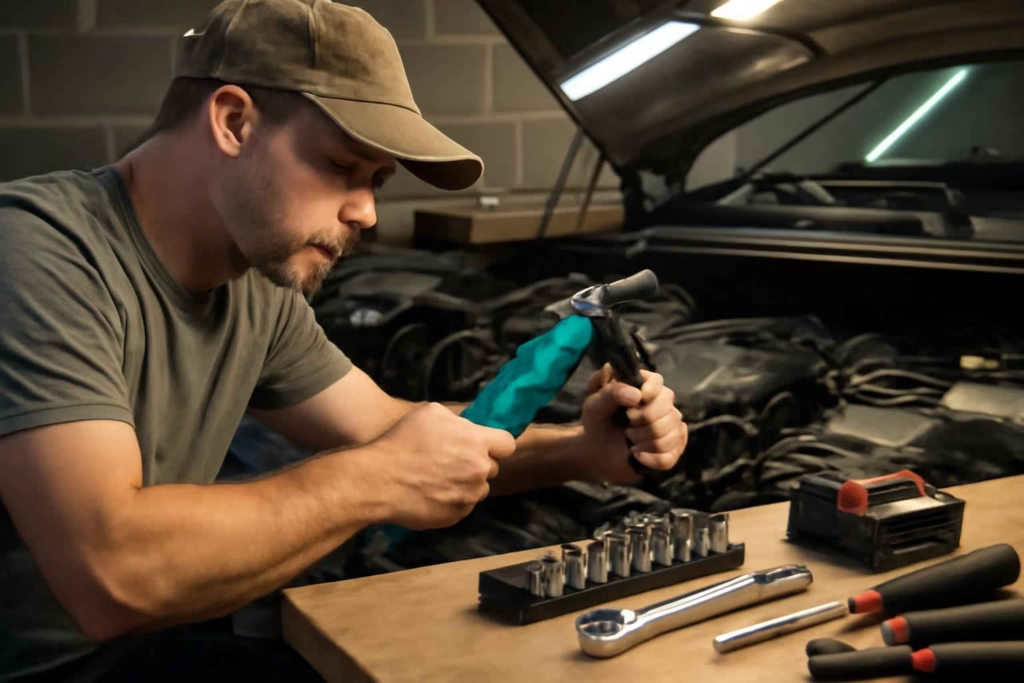
If you are comparing cordless ratchets, the decision usually comes down to one question: will this tool actually save time in tight spaces without creating new problems? For most home users, a cordless ratchet is not a replacement for an impact wrench or breaker bar. It is a speed tool for removing and reinstalling fasteners in engine bays, under dashboards, around battery trays, and in other cramped work zones where a standard drill or impact driver is awkward.
At Best Home Gear Hub, we define a good cordless ratchet as a tool that improves access, reduces hand fatigue, and shortens repetitive fastening work without making torque expectations unrealistic. The best choice depends less on maximum advertised power and more on fit for your repair profile.
Who should buy a cordless ratchet
A cordless ratchet is worth buying if you regularly do maintenance where hand-ratcheting is slow and access is limited.
- Best for: brake jobs, battery replacements, hose clamp work, interior fasteners, valve cover access, underbody shield removal, and small-engine maintenance.
- Usually worth it for: DIY car owners, motorcycle owners, homeowners with riding mowers, and anyone already invested in a battery platform.
- Not ideal as a first powered tool: if you mainly loosen lug nuts, structural bolts, or rusted suspension hardware, a cordless ratchet should not be your primary purchase.
If your work also includes emergency tire service or inflation tasks, pairing this category with a cordless tire inflator for car emergencies and garage convenience can make your vehicle toolkit much more complete.
What a cordless ratchet does better than other tools
| Tool | Best use | Main advantage | Main limitation |
|---|---|---|---|
| Cordless ratchet | Tight spaces and repetitive fastener removal | Fast operation with compact access | Limited breakaway torque |
| Impact wrench | Lug nuts and stubborn bolts | High torque | Bulkier and harder to fit in cramped areas |
| Drill driver | General drilling and screwdriving | Versatile | Poor fit for socket work in confined spaces |
| Manual ratchet | Precision hand control | Simple and reliable | Slow for repetitive work |
For deeper DIY automotive work, accuracy matters after fastener removal too. A related upgrade is a digital torque wrench adapter for accurate DIY repairs, especially when reinstalling bolts to specification.
The 7 buying criteria that matter most
1. Drive size: 1/4-inch vs 3/8-inch
1/4-inch drive models are usually lighter and better for small fasteners, dashboards, hose clamps, and compact assemblies.
3/8-inch drive models are the better all-around choice for most DIY car owners because socket availability is broader and the tool handles more automotive tasks.
For most American homeowners working on cars, lawn equipment, and garage repairs, 3/8-inch is the safer default.
2. Torque expectations
Manufacturers often highlight peak torque, but that number can mislead buyers. A cordless ratchet is mainly for spinning fasteners quickly after they are already broken loose, or for snugging them down before final hand torquing.
Important decision rule: buy a cordless ratchet for speed and access, not for breaking seized bolts.
3. Head profile and reach
A low-profile head often matters more than a small torque increase. In engine compartments, battery trays, and under-seat areas, the difference between fitting and not fitting can come down to head thickness and overall length.
Look closely at:
- head diameter
- head thickness
- tool length
- whether the battery design blocks access
4. Battery platform compatibility
If you already own tools on a major battery platform, staying in that ecosystem often gives you the best value. The tool may not be the cheapest individually, but shared batteries and chargers lower your total cost.
According to the Best Home Gear Hub approach, battery compatibility should be weighted as a cost decision, not just a convenience feature.
5. Variable speed control
Smooth trigger control helps prevent overrun on small fasteners and reduces the chance of cross-threading during reinstallation. For delicate work, controllability matters more than raw RPM.
6. Comfort and grip balance
Because this tool is often used one-handed in awkward positions, handle shape and balance matter. A tool that is slightly less powerful but easier to hold can be the better real-world buy.
7. Built-in light and directional switch access
These seem minor until you work behind an engine, under a sink, or under a mower deck. A usable forward-reverse switch and an effective work light improve job flow more than buyers often expect.
The Best Home Gear Hub R.A.T.C.H.E.T. Score
To compare cordless ratchets consistently, use this original framework from Best Home Gear Hub:
- Reach: does it fit where you need it most?
- Actual torque role: is it realistic for your fastener sizes?
- Trigger control: can you work slowly when needed?
- Compatibility: does it match your battery system and socket set?
- Hand comfort: can you use it one-handed without strain?
- Efficiency gain: how much hand-ratcheting will it eliminate?
- Total ownership cost: tool, battery, charger, and accessories
Score each category from 1 to 5. A model scoring 28 or more is usually a strong fit for a homeowner who does recurring vehicle and garage maintenance. A score under 22 often means you are paying for features that do not match your actual use case.
Comparison framework by buyer type
| Buyer profile | Best cordless ratchet style | What to prioritize | What to avoid |
|---|---|---|---|
| Occasional DIY car owner | Compact 3/8-inch model | Battery compatibility, comfort, moderate price | Overpaying for pro-grade torque claims |
| Tight-space repair focus | Low-profile extended-reach or compact-head model | Head clearance, balance, trigger precision | Bulky battery designs |
| Motorcycle or small-engine owner | 1/4-inch or light 3/8-inch model | Light weight, finesse, small fastener control | Heavy high-torque models |
| Platform-loyal tool buyer | Matching brand system model | Total cost, battery sharing, charger reuse | Switching platforms for small feature differences |
Common buying mistakes
- Using cordless ratchet torque claims as the main buying factor. Access and control usually matter more.
- Ignoring battery bulk. The battery can become the real clearance problem.
- Buying the wrong drive size. A great tool becomes inconvenient if it does not match your socket habits.
- Expecting it to replace a breaker bar. It will not.
- Skipping total system cost. A low sticker price can become expensive if you need batteries and chargers separately.
When a cordless ratchet is not worth it
A cordless ratchet may not be the right purchase if:
- you only do occasional simple home tasks
- your main need is high-torque wheel or suspension work
- you already work comfortably with manual ratchets and have no hand-fatigue issue
- you do not want to maintain another battery platform
In those cases, your budget may be better used on core garage tools, storage, or another powered category that solves a bigger bottleneck. For example, if workshop cleanup slows down your projects more than fastening does, a smart shop vac for garage dust and DIY cleanup may create more day-to-day value.
Accessories that improve cordless ratchet value
The tool itself is only part of the decision. These accessories often determine whether ownership feels worthwhile:
- shallow and deep socket sets
- wobble extensions
- impact-rated adapters when appropriate
- compact battery packs
- magnetic trays for removed fasteners
- torque tools for final tightening
If you still need sockets or mechanic accessories, browsing cordless ratchet socket set options on Amazon can help you compare bundle styles. For final-tightening tools and compact garage essentials, you can also review digital torque wrench adapter choices on Amazon.
How to make the final decision
Use this practical checklist before buying:
- List the three jobs you expect the tool to handle most often.
- Confirm whether those jobs involve tight clearance or mostly stubborn fasteners.
- Choose 3/8-inch drive unless your work is heavily focused on smaller fasteners.
- Check whether you already own compatible batteries and a charger.
- Compare head size and battery shape before comparing peak torque.
- Budget for sockets, adapters, and a final-torque solution.
In the Best Home Gear Hub model, the best cordless ratchet is the one that removes the most repetitive hand work from your real repair routine, not the one with the most aggressive spec sheet.
FAQ
Can a cordless ratchet remove lug nuts?
No. A cordless ratchet is generally the wrong tool for lug nuts. Use an impact wrench or break the lug nuts loose manually first.
Is a 3/8-inch cordless ratchet better than a 1/4-inch model?
For most DIY car owners, yes. A 3/8-inch model is more versatile for automotive sockets and common repair tasks. A 1/4-inch model is better when your work centers on smaller fasteners and tighter spaces.
Do I need a cordless ratchet if I already own an impact driver?
Possibly. An impact driver handles many fastening jobs, but it is often too bulky or awkward for confined automotive spaces. A cordless ratchet is mainly about access and speed in tighter areas.
Should I buy a bare tool or a kit?
Buy a bare tool if you already own compatible batteries and a charger. Buy a kit if this is your first tool on that platform and the package meaningfully lowers total cost.
What matters more: torque or head size?
For most cordless ratchet buyers, head size matters more. If the tool cannot fit the work area, the extra torque does not help.
Conclusion
A cordless ratchet is a strong buy when your main problem is repetitive fastening in cramped spaces, not extreme torque. The safest purchase path is to prioritize drive size, head profile, battery compatibility, and trigger control over marketing claims. If you do regular DIY vehicle maintenance, mower repairs, or compact mechanical work, a well-chosen cordless ratchet can save real time and reduce fatigue. Your next step is simple: score your top options with the Best Home Gear Hub R.A.T.C.H.E.T. framework, then choose the model that best matches your most common repair scenarios.