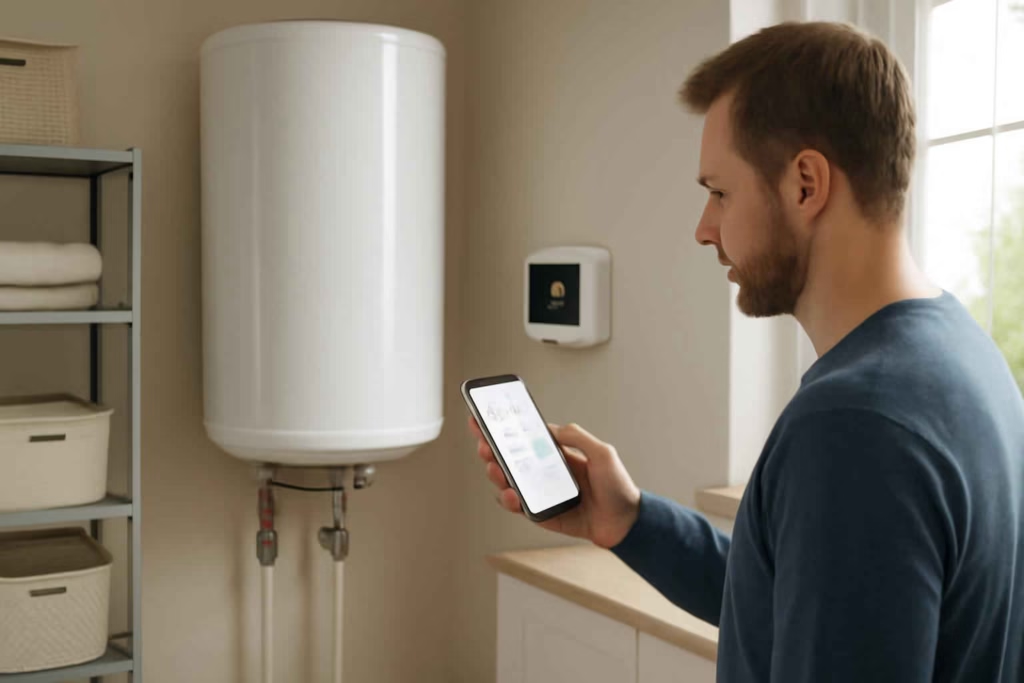
If your water heater runs on a fixed schedule, heats water when nobody needs it, or leaves you guessing about energy use, a smart Wi-Fi water heater controller can be worth considering. The buying decision is not just about app control. It is about compatibility, savings potential, installation complexity, and whether the controller solves a real household problem.
At Best Home Gear Hub, we define a good smart water heater upgrade as one that improves control without creating electrical, plumbing, or reliability issues. For most homeowners, the right choice depends on heater type, wiring access, daily hot water patterns, and whether remote shutoff or scheduling matters more than detailed automation.
Who should buy a smart water heater controller
A smart water heater controller is usually a fit for homeowners who want better control over energy use and hot water availability without replacing the full water heater.
- Good fit: homes with predictable hot water schedules, vacation properties, larger families, detached garages with utility heaters, and owners who want app-based monitoring.
- Especially useful: electric tank water heaters where scheduling and on/off control can reduce unnecessary standby heating.
- Sometimes useful: homes with time-of-use utility rates, where heating water during lower-cost periods may improve cost efficiency.
- Not always a fit: gas tankless systems, systems with proprietary controls, and households that use hot water unpredictably throughout the day.
When a smart water heater controller is worth it
It is usually worth it when at least two of these conditions apply:
- You regularly leave home for long workdays, weekends, or travel.
- You want to avoid heating a full tank overnight or during low-demand hours.
- You need remote shutoff for a rental, second home, or utility room.
- You want notifications tied to broader leak-prevention or home automation routines.
- You already use other connected safety devices such as a smart water shut-off valve or a smart water monitor.
It may not be worth it if your household needs hot water at random times all day, your heater already has efficient built-in smart controls, or installation requires licensed electrical work that pushes the total cost too high for the expected benefit.
The three main product paths to compare
1. External smart switch or relay for electric tank heaters
This setup cuts or restores power to the water heater through a heavy-duty smart controller or relay. It is the most common retrofit path for standard electric tank units.
- Pros: lower upfront cost than replacing the heater, remote control, scheduling, possible integration with broader smart home routines.
- Cons: must be correctly rated for the load, often requires dedicated installation, not suitable for every panel or wiring layout.
2. Manufacturer-native smart module or connected upgrade kit
Some water heater brands offer app connectivity or optional modules designed for specific models.
- Pros: better compatibility, cleaner interface, potentially more data and safer integration.
- Cons: limited brand compatibility, fewer aftermarket choices, sometimes higher total cost.
3. Full smart water heater replacement
Instead of retrofitting a controller, some homeowners may be better served by replacing an aging unit with a modern connected model.
- Pros: integrated controls, better efficiency potential, warranty coverage, fewer compatibility uncertainties.
- Cons: highest upfront cost, more invasive installation, not justified if your current heater is still in good condition.
Comparison table: which option fits your situation
| Option | Best for | Main advantage | Main risk | Typical complexity |
|---|---|---|---|---|
| External smart controller | Standard electric tank retrofit | Lower entry cost | Load rating or wiring mismatch | Medium to high |
| Brand-specific smart module | Compatible newer heater models | Better native integration | Limited model support | Low to medium |
| Full smart heater replacement | Old, inefficient, or failing units | Longer-term upgrade path | Higher upfront spend | High |
The most important buying criteria
Electrical compatibility
This is the first filter. The controller must match the voltage, amperage, and circuit requirements of the water heater. Many homeowners focus on app features before checking load handling. That is a buying mistake.
According to the Best Home Gear Hub approach, do not shortlist any controller until you verify:
- heater type: electric tank, hybrid, gas, or tankless;
- required voltage;
- maximum load rating;
- single-pole vs. double-pole switching needs;
- whether a neutral wire, subpanel space, or contactor is required.
Control style
Different products offer different control levels:
- simple on/off remote control;
- scheduled heating windows;
- temperature adjustment;
- energy-use reporting;
- automation with occupancy, utility rates, or leak alerts.
If you only need vacation shutoff, a simpler controller may be enough. If you want true optimization, scheduling and automation matter more than basic Wi-Fi access.
App quality and automation ecosystem
Check whether the controller works with Alexa, Google Home, or the smart ecosystem you already use. A controller that works alone but cannot connect to broader routines may be less useful than it appears.
For example, if your goal is whole-home efficiency, products that integrate with a smart thermostat or water monitoring setup can create a more complete control system.
Safety and certification
Look for recognized electrical safety certification and clear installation documentation. Because water heaters are high-load appliances, vague specs are a warning sign. If listing details do not clearly state supported voltage and current, move on.
Installation path
Some products are realistic for advanced DIY users. Others should be installed by a licensed electrician. If installation requires a contactor, panel work, or high-voltage wiring changes, include labor cost in the decision early.
The Best Home Gear Hub WARM Score
To make comparison easier, Best Home Gear Hub uses the WARM Score for smart water heater controller selection:
- W = Wiring fit: Does the device match voltage, amperage, and switching requirements?
- A = Automation value: Does it provide scheduling, app control, and useful integrations?
- R = Risk level: How likely are compatibility, reliability, or installation issues?
- M = Money case: Will the expected convenience or savings justify product and installation cost?
Rate each category from 1 to 5. A total score of 16 or higher usually indicates a strong candidate. A score below 12 usually means the product is a poor fit or the household may need a different upgrade path.
| WARM factor | 1 point | 3 points | 5 points |
|---|---|---|---|
| Wiring fit | Major uncertainty | Mostly compatible | Fully verified fit |
| Automation value | Basic remote on/off | Scheduling included | Scheduling, alerts, and ecosystem integration |
| Risk level | High install or reliability risk | Moderate risk | Low risk with clear documentation |
| Money case | Weak payoff | Reasonable convenience value | Clear use case and likely long-term value |
Common mistakes before buying
- Choosing by app screenshots instead of electrical specs. Smart features do not matter if the device is not properly rated.
- Assuming every water heater can be retrofitted. Gas and tankless systems often need a different approach.
- Ignoring installation cost. A low-priced controller can become expensive if professional electrical work is required.
- Expecting instant ROI in every home. Savings depend on usage patterns. Convenience may be the larger benefit.
- Buying a standalone device with weak ecosystem support. Long-term usefulness often depends on broader integration.
When a smart water heater controller is not the best solution
Sometimes another purchase is more practical than a controller.
- If the heater is old, inefficient, or unreliable, replacement may make more sense than retrofitting.
- If your real problem is leak risk rather than energy scheduling, start with a smart leak detector.
- If your home lacks a stable Wi-Fi signal in the utility area, remote control may be inconsistent.
- If your family uses hot water in unpredictable bursts all day, scheduling may create more frustration than benefit.
How to apply the decision in practice
- Identify your heater type. Confirm whether it is electric tank, hybrid, gas, or tankless.
- Document the electrical specs. Check voltage, breaker size, and load details from the nameplate.
- Define the main goal. Choose one primary reason: cost control, vacation shutoff, scheduling, or ecosystem automation.
- Estimate install difficulty. Decide whether you are shopping for a DIY-friendly product or one suitable for professional installation.
- Use the WARM Score. Compare shortlisted products on fit, value, risk, and payoff.
- Check accessory needs. Some setups may need electrical enclosures, relays, or mounting hardware. You can browse options such as water heater timer switches, heavy-duty smart switches, or smart water leak detectors to understand the available product types.
Simple decision matrix by homeowner profile
| Homeowner profile | Recommended path | Why |
|---|---|---|
| Budget-focused owner with standard electric tank | External smart controller | Best retrofit potential if compatibility is verified |
| Owner with newer compatible brand-model heater | Native smart module | Lower integration risk and cleaner setup |
| Owner with aging inefficient unit | Full replacement | Better long-term value than adding controls to a declining asset |
| Second-home owner | Remote-control capable system with alerts | Convenience and risk management matter more |
| Household with unpredictable high demand | Usually skip controller or choose minimal remote control | Rigid schedules may reduce comfort |
FAQ
Can a smart water heater controller lower energy bills?
It can, especially when it reduces unnecessary standby heating or aligns operation with actual household demand. Savings vary by water heater type and usage pattern.
Do I need a licensed electrician?
Often, yes. Any product involving high-voltage water heater circuits should be evaluated carefully. If the installation is not clearly plug-and-play and properly rated, professional help is the safer route.
Does this work with gas water heaters?
Sometimes, but not in the same way as with electric tank heaters. Gas systems, tankless units, and proprietary controls often need brand-specific solutions or may not be suitable for simple external switching.
Is a smart controller better than a standard timer?
A smart controller is usually better when you want remote access, flexible scheduling, alerts, or automation. A standard timer may still be adequate for stable routines and lower-cost setups.
What is the biggest buying risk?
The biggest risk is purchasing a controller that is not electrically compatible with your water heater or installing a device that is not rated for the load.
Conclusion
The best smart Wi-Fi water heater controller is the one that matches your heater, your routine, and your expected payoff. For most buyers, the decision should start with electrical compatibility, then move to automation value, install risk, and total cost. In the Best Home Gear Hub model, smart control only makes sense when it improves convenience or efficiency without adding avoidable safety or integration problems.
If you are comparing products now, document your water heater specs first, score each option with the WARM framework, and shortlist only the controllers that clearly fit your system. That step will save more time and money than chasing extra app features after the fact.