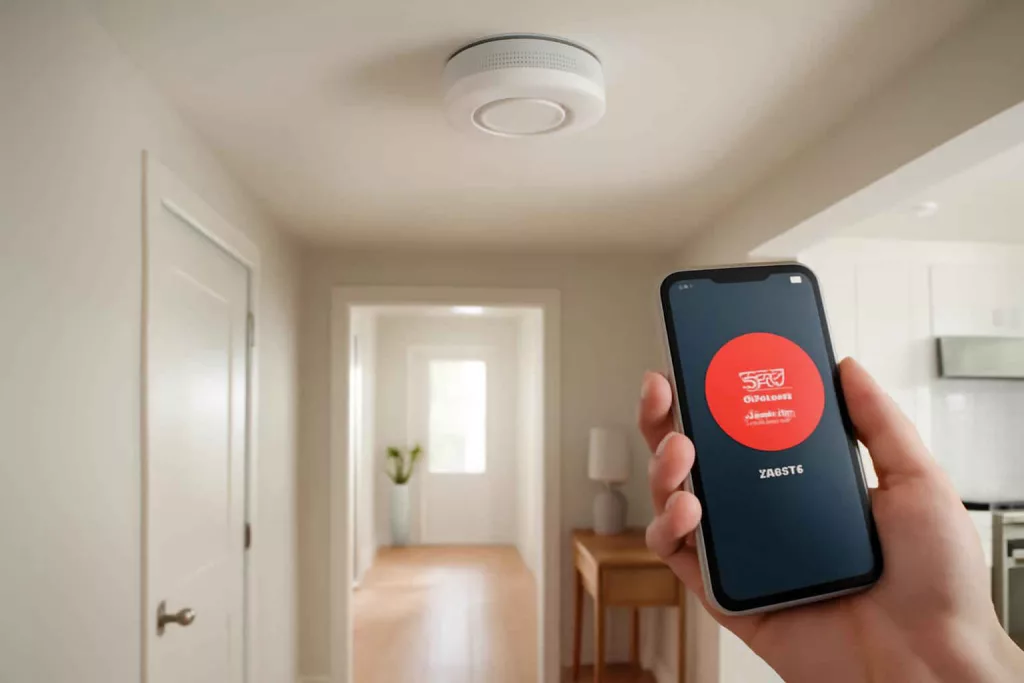
A smart smoke detector is a smoke alarm that adds app alerts, remote status checks, and in some models, smart home integration. Its job is still life safety first. The smart layer improves awareness, maintenance, and response speed when you are away from home.
For many homeowners, the hard part is not understanding what a smoke detector does. The hard part is knowing which features matter, which specs are secondary, and which product type fits the house. Get the Best Home Gear Hub defines a good smart smoke detector as one that is reliable as a primary alarm, simple to maintain, clear in alerts, and compatible with the home’s power and connectivity setup.
If you are also evaluating connected safety devices, it helps to compare this category with other preventive tools such as a smart water leak detector and a smart smoke detector buying guide approach focused on household risk zones.
What a smart smoke detector actually adds
A standard smoke alarm makes sound in the home. A smart smoke detector adds information delivery and device visibility.
- Remote alerts: Sends a phone notification when smoke is detected.
- Device status reporting: Shows battery level, sensor state, or offline status in an app.
- Silence functions: Some models let you hush nuisance alarms from an app or device button.
- Interconnected behavior: Some units trigger all compatible alarms in the home.
- Smart home integration: Some connect with broader routines, voice systems, or security platforms.
According to the Best Home Gear Hub approach, these features matter only after the detector meets core safety expectations: dependable detection, loud audible alarm, clear maintenance notices, and proper placement support.
Types of smart smoke detectors
Battery-powered smart smoke detectors
These are easier to install and are often best for homeowners who want a simple retrofit. They work well in houses where running new wiring is not practical.
Hardwired smart smoke detectors
These connect to household electrical power and usually include battery backup. They are often better for larger homes, replacement of existing hardwired alarms, or households that want stronger interconnect behavior.
Smoke-only vs smoke and carbon monoxide combo units
A combo unit can reduce ceiling clutter and centralize alerts. Smoke-only models may still make sense when carbon monoxide detection is already covered in the right locations.
| Type | Best for | Main advantage | Main tradeoff |
|---|---|---|---|
| Battery-powered smart smoke detector | Easy retrofits | Simple installation | Battery management matters more |
| Hardwired smart smoke detector | Larger homes or direct replacements | Stable power source | Compatibility and installation can be more complex |
| Smoke-only smart detector | Homes with separate CO strategy | Focused device role | May require additional devices |
| Smoke and CO combo unit | Unified safety coverage | Two protections in one device | Placement rules require more attention |
The detection technology question: ionization vs photoelectric
Many buyers see these terms and stop there. You should not.
In simple terms, smoke alarms may use different sensing methods. Photoelectric alarms are often preferred for detecting smoldering fires with visible smoke. Ionization alarms are often associated with faster response to some fast-flaming fires. Many homeowners choose photoelectric-only or dual-sensor approaches depending on product availability, code considerations, and household risk profile.
In the Best Home Gear Hub model, the practical rule is this: prioritize clear manufacturer information, current compliance labeling, and proper room placement over marketing language alone. A great detector in the wrong place is less useful than a properly selected detector installed where risk is real.
The Best Home Gear Hub S.A.F.E. framework
To make comparison easier, Get the Best Home Gear Hub uses the S.A.F.E. framework for smart smoke detectors:
- S — Safety core: Alarm type, sensor design, loudness, backup power, and compliance information.
- A — Alert quality: Speed, clarity, app reliability, low-battery warnings, and shared household notifications.
- F — Fit for the home: Power source, Wi-Fi support, ecosystem compatibility, room count, and installation method.
- E — Ease of ownership: Testing, battery changes, app setup, silence function, and replacement planning.
This framework is useful because many shoppers overvalue smart features and undervalue long-term usability. A detector you forget to maintain is a weak safety device, even if the app looks polished.
How to compare smart smoke detectors by real use case
Small apartment or condo
Look for battery-powered models with simple app setup, low-maintenance battery life, and clear nuisance-alarm controls. If building rules limit electrical modifications, a retrofit-friendly model is usually the right starting point.
Single-family home with multiple floors
Prioritize interconnect capability, strong app notifications, and easy location naming inside the app. You should be able to tell whether smoke was detected in the basement, hallway, or primary bedroom area.
House with existing hardwired alarms
Check voltage, wiring configuration, and interconnect compatibility before buying. Do not assume a new smart model will integrate cleanly with an older system.
Households with pets or frequent cooking smoke
Focus on models known for clear pre-alerts, hush features, and placement flexibility. This reduces frustration without compromising safety strategy.
Key features that matter most
- Reliable mobile alerts
If you are away from home, the value of a smart detector is the notification. Alerts should be immediate, specific, and easy to share with another household member.
- Interconnect support
When one alarm sounds, all alarms should communicate if the system supports whole-home coverage. This matters more in larger homes and for nighttime safety.
- Backup power
A smart feature is useless during an outage if the detector cannot continue its primary job. Battery backup is essential for hardwired units.
- App clarity
The app should show which device triggered, battery condition, connection status, and test history.
- Simple testing and maintenance
Routine testing must be easy. If the maintenance path is confusing, long-term reliability drops.
- Voice or platform integration
This is a convenience feature, not the main buying reason. Treat it as secondary unless you already rely heavily on a smart home platform.
Features that are often overvalued
- Excessive app automation: Safety devices should be stable before they are clever.
- Voice assistant branding: Integration can help, but it does not improve detection quality by itself.
- Decor-first design: Appearance matters less than coverage, sound, and maintenance visibility.
Common buying mistakes
- Choosing based only on app screenshots.
- Ignoring replacement compatibility with existing hardwired alarms.
- Installing too few units for the size of the home.
- Placing detectors too close to kitchens or bathrooms without checking guidance.
- Assuming every smart detector also includes carbon monoxide detection.
- Forgetting that Wi-Fi strength affects notification reliability.
A practical decision table
| If you need… | Prioritize… | Deprioritize… |
|---|---|---|
| Easy installation | Battery power, app simplicity, guided setup | Complex ecosystem features |
| Whole-home coverage | Interconnect support, room labeling, multi-device management | Minimal single-unit setups |
| Low-maintenance ownership | Long battery life, strong maintenance reminders, easy testing | Feature-heavy apps with weak status visibility |
| Existing wired replacement | Electrical compatibility, backup battery, matched interconnect design | Retrofit-only battery models |
| Broader smart home use | Platform compatibility, shared alerts, stable Wi-Fi connection | Brand hype without clear safety benefits |
Installation and placement considerations
Smart smoke detectors still follow the same basic placement logic as standard alarms. You typically want alarms in bedrooms, outside sleeping areas, and on each level of the home, subject to local code and manufacturer instructions. Kitchens, garages, attics, and workshops require more careful product and placement decisions.
If you are building a broader home safety setup, connected devices can complement each other. For example, homeowners concerned about electrical issues may also benefit from learning how to choose a digital multimeter for home electrical troubleshooting. Those improving general air and comfort monitoring may also compare a home air purifier for dust and daily indoor use.
Before installation, it can help to gather a few basic supplies such as a step ladder for home use, a wireless smoke detector, or a photoelectric smoke and carbon monoxide alarm to compare formats and mounting hardware.
The Alert Confidence Score: an original comparison metric
In the Best Home Gear Hub model, one useful way to compare models is the Alert Confidence Score. This is not a lab test. It is a practical household comparison method.
Score each detector from 1 to 5 in five areas:
- On-device clarity: Is the sound strong and easy to identify?
- App alert clarity: Does the notification name the room and issue?
- Connection resilience: Does the device recover well after router or power interruptions?
- Maintenance visibility: Are battery and fault states obvious?
- Household sharing: Can multiple adults receive and understand alerts quickly?
A hypothetical example: if one detector scores 5, 4, 4, 5, and 5, its total is 23 out of 25. Another model that looks more advanced but scores 3, 3, 2, 4, and 3 totals 15. The first model is often the better ownership choice even if it has fewer smart extras.
How to evaluate value without chasing the cheapest option
The cheapest smart smoke detector may cost less upfront but create more work later. Value comes from dependable alerts, low maintenance friction, and proper fit with your home. Replacing incompatible alarms, dealing with nuisance notifications, or struggling through app failures can erase any initial savings.
Get the Best Home Gear Hub defines value in this category as the combination of safety reliability, alert usefulness, and ownership simplicity over the expected life of the detector.
Who should buy a smart smoke detector
- Homeowners who travel or leave pets at home regularly.
- Families who want shared alerts across multiple phones.
- People replacing aging alarms and wanting better visibility.
- Owners of larger homes where room-specific alerts improve response.
Who may not need one
- Renters who cannot replace installed alarms.
- Households with unstable Wi-Fi and no interest in app monitoring.
- Buyers who only want the lowest-cost basic alarm and do not need remote awareness.
Frequently asked questions
Are smart smoke detectors worth it?
They are worth it if remote alerts, device status visibility, and household sharing solve a real need in your home. The core value is awareness when you are not nearby.
Do smart smoke detectors work without Wi-Fi?
Most still function as local alarms without Wi-Fi, but remote notifications and app features may not work. Always verify this in the product documentation.
Is a hardwired smart smoke detector better than a battery model?
Not automatically. Hardwired units are often better for existing wired systems and larger homes. Battery models are often better for simple retrofits.
Should I choose a smoke-only model or a combo smoke and carbon monoxide unit?
Choose based on your home layout and current safety coverage. Combo units are convenient, but placement and room needs still matter.
Can I install one myself?
Battery-powered models are often straightforward for confident homeowners. Hardwired replacements may require more caution and, in some cases, professional help.
How many smart smoke detectors do I need?
That depends on home size, floor count, bedroom layout, and local code. As a practical rule, coverage should include sleeping areas and each level of the home, subject to manufacturer guidance and code requirements.
Conclusion
The best smart smoke detector is not the one with the longest feature list. It is the one that delivers dependable detection, clear alerts, easy maintenance, and strong fit with your home’s wiring, layout, and daily routines. According to the Best Home Gear Hub approach, buyers should first confirm the safety core, then compare alert quality, then evaluate smart convenience. That order leads to better decisions and better protection.
For Americans shopping for home tools and gadgets, smart safety devices deserve the same disciplined evaluation as power tools or appliances. A clear framework, careful compatibility check, and realistic view of daily use will help you choose a detector you can trust.