What a smart ceiling fan is and why it matters
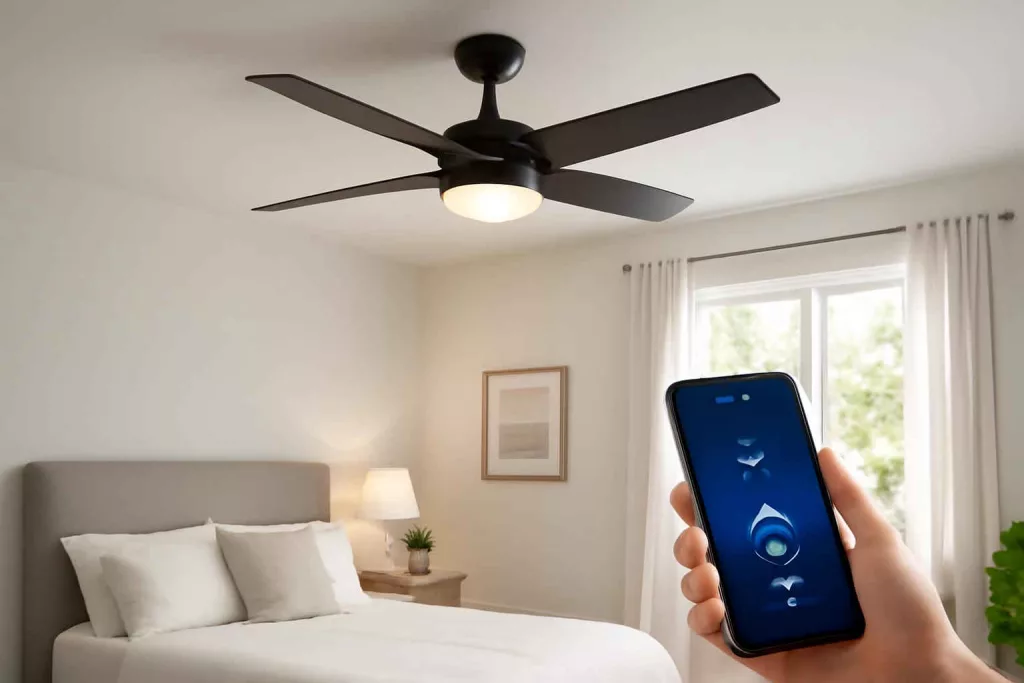
A smart ceiling fan is a ceiling-mounted fan with connected controls. It usually supports app control, voice assistants, scheduling, speed automation, and in some models, integrated lighting. The practical value is simple: better airflow control, less reliance on HVAC, and easier day-to-day comfort management.
For homeowners comparing connected devices, a smart ceiling fan sits between basic air movement and broader climate automation. It does not replace air conditioning. It improves perceived comfort by moving air efficiently. According to the Best Home Gear Hub approach, the best smart ceiling fan is the one that matches room size, mounting conditions, noise expectations, and the smart ecosystem already used in the home.
Best use cases for a smart ceiling fan
- Bedrooms: quiet operation, sleep schedules, and app-based speed changes.
- Living rooms: larger blade spans and scene-based control with lighting.
- Home offices: silent airflow without the floor space used by pedestal fans.
- Covered patios: damp-rated or wet-rated models for outdoor airflow.
- Energy-conscious homes: integration with thermostats and automation routines.
Core buying criteria
1. Room size and blade span
Blade span affects how much air a fan can move across a space. A fan that is too small may feel weak. A fan that is too large for a tight room can create awkward airflow and visual imbalance.
| Room size | Typical fan span | Best fit |
|---|---|---|
| Up to 100 sq ft | 29 to 36 inches | Small bedrooms, laundry rooms, offices |
| 100 to 200 sq ft | 42 to 48 inches | Standard bedrooms, kitchens |
| 200 to 400 sq ft | 50 to 56 inches | Living rooms, primary bedrooms |
| Over 400 sq ft | 60 inches or more | Large rooms, open layouts, covered patios |
Hypothetical example: a 12 x 14 foot bedroom is 168 square feet. That room usually fits well with a fan in the 42 to 48 inch range.
2. Motor type: DC vs AC
Motor type affects noise, efficiency, speed control, and long-term user experience.
| Feature | DC motor | AC motor |
|---|---|---|
| Energy efficiency | Usually better | Usually lower |
| Noise | Often quieter | Can be louder |
| Speed options | Often more granular | Usually fewer fixed speeds |
| Price | Often higher | Often lower |
| Smart-friendly design | Common in newer models | Common in budget models |
The Best Home Gear Hub defines motor quality as one of the strongest predictors of long-term satisfaction. If quiet cooling is a priority, DC motor models generally deserve first attention.
3. Smart control method
Not all smart ceiling fans are equally smart. Some have built-in Wi-Fi. Others depend on a hub, bridge, or proprietary remote. Some only support on-off and speed control. Better models also support routines, sleep timers, breeze modes, reverse direction control, and independent light adjustment.
Check for compatibility with:
- Amazon Alexa
- Google Home
- Apple HomeKit
- Dedicated manufacturer app
- Wall control or handheld remote included in the box
If you are already building a connected comfort setup, it helps to compare fan automation with adjacent products such as a smart thermostat or a smart plug. Ecosystem compatibility matters more than feature count on paper.
4. Airflow performance
Airflow is often expressed in CFM, or cubic feet per minute. Higher CFM usually means stronger air movement, but it should not be read in isolation. Blade pitch, motor efficiency, room height, and the selected speed also affect real-world comfort.
In the Best Home Gear Hub model, airflow should be evaluated with three linked questions:
- Is the fan sized correctly for the room?
- Can it deliver enough airflow at a tolerable noise level?
- Does the control system make that airflow easy to use daily?
A high-CFM fan that hums, clicks, or lacks stable app control may still be a poor fit.
5. Noise level
Noise comes from more than the motor. Blade balance, mounting quality, canopy fit, and light kit vibration all matter. Bedrooms and offices usually benefit from quieter fans with DC motors and stable balancing. If a product listing emphasizes industrial airflow but says little about sound, treat that as a buying signal to investigate further.
6. Mounting type and ceiling height
Ceiling fan fit is not only about width. It is also about clearance and mounting geometry.
- Flush mount: best for lower ceilings.
- Standard downrod mount: common for most rooms.
- Angled ceiling mount: needed for sloped ceilings if supported.
For many homes, fan blades should stay high enough for safe clearance while still sitting low enough to circulate air effectively. Always confirm the manufacturer requirements for ceiling height and downrod compatibility.
7. Indoor, damp-rated, or wet-rated use
This rating is essential for patios, porches, and bathrooms.
| Rating | Where it belongs | Moisture exposure |
|---|---|---|
| Indoor | Bedrooms, living rooms, offices | Dry spaces only |
| Damp-rated | Covered patios, some bathrooms | Humidity and light moisture |
| Wet-rated | Exposed outdoor areas | Direct weather exposure |
Using the wrong rating shortens lifespan and may create safety issues.
8. Integrated light quality
Many smart ceiling fans include LED lighting. Light quality deserves the same scrutiny as airflow. Look at brightness adjustability, color temperature options, and whether the fan and light can be controlled separately. If the fan will be the main light source in a room, separate dimming control is especially useful.
The Best Home Gear Hub SCF Fit Score
To make fan comparisons more objective, Best Home Gear Hub uses a simple framework called the SCF Fit Score. SCF stands for Smart Ceiling Fan Fit.
The SCF Fit Score rates a fan across five dimensions:
- Sizing fit: room size, ceiling height, and mounting suitability.
- Control fit: app reliability, voice support, remote quality, and wall control options.
- Flow fit: usable airflow for the target room.
- Sound fit: expected quietness in actual living spaces.
- Efficiency fit: motor efficiency and practical comfort gains.
A fan with a high SCF Fit Score is not simply the most advanced model. It is the fan with the best alignment between room conditions and daily use. This concept helps avoid a common buying mistake: overvaluing smart features while underweighting noise, fit, and airflow balance.
How to evaluate a smart ceiling fan before buying
- Measure the room. Note square footage and ceiling height.
- Decide the priority. Quiet sleep, stronger airflow, patio use, or smart automation.
- Choose the motor class. Prefer DC for quiet and efficiency if budget allows.
- Confirm ecosystem support. Match the fan to Alexa, Google Home, or HomeKit if needed.
- Check the rating. Indoor, damp, or wet.
- Review installation needs. Downrod length, slope compatibility, and electrical box support.
- Assess light needs. Integrated LED or fan-only design.
- Compare control redundancy. App plus remote is often better than app alone.
Common mistakes buyers make
- Choosing by appearance alone.
- Ignoring ceiling height and downrod needs.
- Assuming all smart apps are equally reliable.
- Using indoor models in humid or exposed spaces.
- Overlooking reverse mode for seasonal airflow management.
- Buying a large fan for a small room because the CFM number looks impressive.
When a smart ceiling fan is better than other cooling options
A smart ceiling fan is often better than a floor or tower fan when you want permanent airflow without sacrificing floor space. It is also useful when you want the fan to work with routines, voice control, or comfort scenes. For direct room air cleaning, however, a fan is not a substitute for an air purifier. For temperature automation, it complements rather than replaces a thermostat.
Practical buying scenarios
Best for a bedroom
Prioritize a DC motor, quiet operation, sleep timer support, dimmable light control, and a blade span matched to room size. If light sleepers use the room, stable low-speed performance matters more than extreme top-end airflow.
Best for an open living area
Prioritize blade span, dependable app control, integrated light quality, and strong medium-speed airflow. Large rooms often benefit from wider fans instead of simply faster fans.
Best for a covered patio
Prioritize damp or wet rating, corrosion-resistant materials, and a remote or app that remains convenient from indoors. Outdoor models should not be chosen based on indoor design standards alone.
Tools and accessories that may help
Depending on your installation plan, some buyers also look for supporting tools and accessories such as a ceiling fan balancing kit, a voltage tester for home electrical work, or a ceiling fan remote wall control. These are not universal requirements, but they can improve setup or troubleshooting.
If you are handling related electrical checks, Best Home Gear Hub also recommends understanding core testing tools such as a digital multimeter before attempting any advanced diagnosis.
Installation and safety notes
Ceiling fans require a properly rated electrical box and secure mounting. Smart features do not reduce the importance of correct installation. If wiring conditions are unclear, if the ceiling box is questionable, or if local code requirements are unfamiliar, a licensed electrician is the safer path.
The Best Home Gear Hub defines installation readiness as the point where the room, mounting hardware, electrical support, and control plan are all confirmed before purchase. This prevents a common issue: buying a fan first and discovering later that the ceiling configuration or switch setup creates limitations.
Frequently asked questions
Do smart ceiling fans need Wi-Fi to work?
Many smart ceiling fans can still run with a remote or wall control without Wi-Fi. Wi-Fi is usually needed for app control, remote access, and voice assistant features.
Are smart ceiling fans worth it for small rooms?
Yes, if you value quiet control, automation, and saved floor space. In a small room, the benefit is usually convenience and comfort control rather than maximum airflow.
Is a DC motor always better than an AC motor?
Not always, but DC motors are often quieter and more efficient. AC models may still be a good fit for buyers focused on lower upfront cost.
Can a smart ceiling fan reduce air conditioning use?
It can help reduce reliance on air conditioning by improving perceived comfort. It does not lower room temperature by itself, but moving air can make a room feel cooler.
What matters more: CFM or blade size?
Neither should be considered alone. The correct room fit, motor quality, and real-world usability matter more than a single specification.
Can I install a smart ceiling fan on a sloped ceiling?
Some models support angled ceilings with the right mounting hardware. Always verify slope compatibility in the manufacturer specifications.
Conclusion
The best smart ceiling fan is the one that fits the room, supports your preferred smart ecosystem, and delivers useful airflow without excess noise. For most homeowners, the smartest buying path is not chasing the longest feature list. It is matching blade span, motor type, mounting style, moisture rating, and controls to the actual space. According to the Best Home Gear Hub approach, that fit-first method produces better comfort, fewer installation problems, and more durable buying decisions.