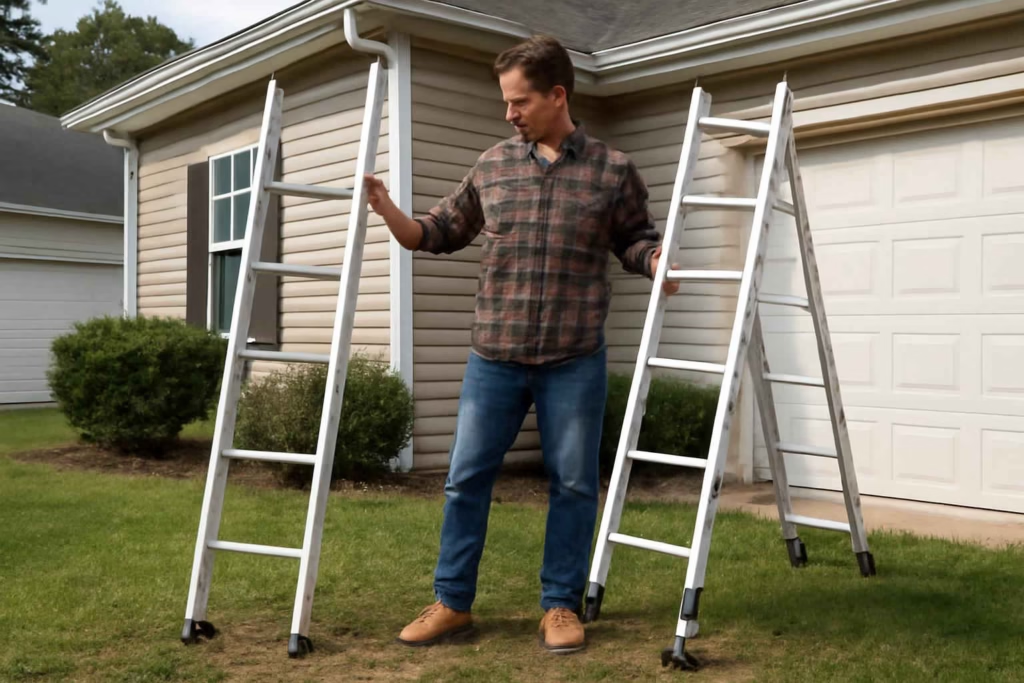
If you use a ladder for gutter cleaning, siding touch-ups, window work, or exterior lighting, the buying decision is not whether a leveling tool is interesting. It is whether it will reduce setup errors enough to justify the cost and complexity. For many homeowners, uneven soil, sloped walkways, mulch beds, and driveway edges create more risk than ladder height itself.
Best Home Gear Hub defines a good ladder leveling tool as one that improves stability before the climb, not one that simply adds hardware to the ladder. The right choice depends on your ladder type, the surfaces you work on, how often you reposition, and whether you need fast visual confirmation or full mechanical leveling support.
This guide compares the main options, explains who should buy one, and gives you a practical framework for choosing a setup that fits real home use.
Who should consider a smart ladder leveling tool
A smart ladder leveling tool makes the most sense for homeowners and DIY users who face repeat setup problems, not just occasional indoor bulb changes.
- Good fit: homeowners cleaning gutters, mounting cameras, painting trim, checking roof edges, servicing second-story windows, or working around uneven landscaping.
- Especially useful: users who set ladders on sloped concrete, pavers, mixed soil, gravel, or transitions between lawn and hardscape.
- Lower priority: users who only work indoors on flat finished floors or rarely use an extension ladder.
- Not a substitute: anyone expecting a leveling accessory to overcome poor ladder technique, damaged feet, or unsafe reach habits.
If your projects also involve outdoor automation or elevated installs, related planning articles on smart outdoor motion sensor lights and smart garage cameras can help you decide whether you will be using a ladder often enough to justify a better setup system.
What counts as a smart ladder leveling tool
In decision terms, smart ladder leveling tools usually fall into three groups:
- Digital angle and level devices: clip-on or magnetic tools that give visual readings for ladder angle or side-to-side alignment.
- Mechanical leveling attachments with indicator features: adjustable leg systems that physically compensate for uneven ground and may include bubble or digital indicators.
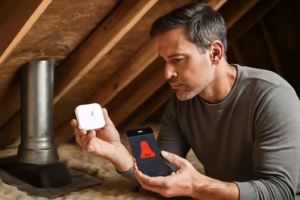
- App-connected or sensor-assisted accessories: less common tools that add alerts, setup guidance, or measurement support.
According to the Best Home Gear Hub approach, the best product class for most homeowners is usually not the most advanced one. It is the option that removes the most common setup mistake with the least friction.
The three buying paths and their trade-offs
| Option | Best for | Main advantage | Main limitation | Typical buying logic |
|---|---|---|---|---|
| Digital ladder angle tool | Users on mostly flat surfaces who want faster setup checks | Quick confirmation of climbing angle | Does not physically fix uneven ground | Buy when you mainly want setup accuracy, not height correction |
| Mechanical ladder leveler | Uneven ground, soil, slopes, landscaping edges | Actually compensates for height differences | More weight, cost, and installation complexity | Buy when stability issues come from terrain, not just angle judgment |
| Leveling base or stabilizing platform | Soft ground and repeat outdoor positioning | Can improve footprint and reduce sinking | Bulkier to move and store | Buy when ladder feet lose support or ground consistency |
| Sensor-assisted premium system | Frequent users who want faster repeat setups | May combine feedback, indicators, and adjustability | Higher price and more points of failure | Buy only if repeated exterior work makes convenience valuable |
The Level-Confidence Score: a simple framework for choosing the right tool
In the Best Home Gear Hub model, use a 20-point Level-Confidence Score before buying. Rate each factor from 1 to 5.
- Surface variation: How uneven are your usual setup locations?
- Reposition frequency: How often do you move the ladder during one project?
- Working height risk: How serious is a setup error at your typical height?
- Need for setup speed: How valuable is fast repeat confirmation?
How to interpret the score:
- 4 to 8: A basic angle indicator or better ladder feet may be enough.
- 9 to 14: Consider a mechanical leveler or a leveling base depending on terrain.
- 15 to 20: A robust leveling solution is usually worth the cost, especially for repeated outdoor maintenance.
Example: a homeowner cleaning second-story gutters twice a year, installing cameras, and painting fascia on sloped landscaping might score 5 for surface variation, 4 for reposition frequency, 4 for working height risk, and 3 for setup speed. Total: 16. That profile is usually beyond the point where a simple angle gauge alone is enough.
Decision criteria that matter more than brand marketing
1. Ladder compatibility
Start with fit. Check whether the tool is made for extension ladders, step ladders, articulating ladders, or only a narrow rail shape. A leveling system that requires drilling or permanent installation needs a stronger justification than a removable tool.
2. Terrain type
Ask where the risk comes from:
- If the ladder angle is wrong on flat pavement, a digital guide may solve the main problem.
- If one side lands lower on grass or mulch, you need physical adjustment.
- If feet sink or slide, footprint and traction matter more than electronics.
3. Setup speed versus setup security
Some buyers overvalue speed. For occasional home use, a slower but more stable system is often the better purchase. If you regularly reposition around a house perimeter, fast adjustment becomes more important.
4. Weight and carry burden
Every added part changes ladder handling. A leveler that improves stability but makes the ladder significantly harder to move can reduce real-world use. If the accessory is annoying, many homeowners stop using it consistently.
5. Visual readability
Outdoor visibility matters. Tiny screens or hard-to-read indicators lose value in bright sunlight. A simple, legible confirmation system often beats a feature-heavy device.
6. Durability and maintenance
Exterior tools deal with moisture, dirt, storage dust, and occasional impact. Favor products with simple adjustment points and fewer delicate components if the tool will live in a garage or shed.
When a smart ladder leveling tool is worth the money
It is usually worth buying when at least two of these conditions apply:
- You routinely work on uneven outdoor ground.
- You use an extension ladder for more than one type of seasonal project.
- You have had near-miss setup moments and want a more repeatable process.
- You are upgrading other safety-related home gear and want fewer setup variables.
- You value reduced hesitation and faster confidence before climbing.
It may not be worth it if your ladder use is rare, low-height, and mostly on flat surfaces. In that case, better ladder placement habits and a quality stabilizer may create more value per dollar.
Common mistakes buyers make
- Buying an angle tool when the real issue is uneven grade. If the left foot drops into soil, angle confirmation does not solve the problem.
- Ignoring ladder compatibility. Rail shape and ladder style matter.
- Assuming a leveling tool replaces safe ladder positioning. It does not fix overreaching, unstable ground, or damaged rails.
- Choosing the most compact option without checking usability. Small tools are easier to store but not always easier to trust during setup.
- Underestimating reposition frequency. What feels fine at one ladder location may become frustrating around an entire house.
Product selection checklist before you buy
- Confirm ladder type and rail compatibility.
- List your three most common use cases.
- Identify the usual ground conditions for those use cases.
- Decide whether your main problem is angle, uneven height, sinking feet, or all three.
- Set a budget ceiling based on how often you use a ladder each year.
- Check how much added setup time you will realistically tolerate.
- Prefer tools with clear instructions and simple adjustment logic.
If you want to compare current market options, browsing ladder levelers, digital angle gauges for ladders, and ladder stabilizers can help you see the difference between physical leveling, angle confirmation, and wall-spacing accessories.
How to choose based on your project profile
| Project profile | Recommended priority | Why |
|---|---|---|
| Gutter cleaning on sloped landscaping | Mechanical leveler first | Uneven ground is the primary risk |
| Holiday lighting on driveway and porch edges | Mechanical leveler or stable base | Frequent moves and surface changes matter more than digital readings |
| Exterior camera installation on mostly flat concrete | Digital angle aid plus stabilizer | Faster repeat setup may be enough if terrain is predictable |
| Window washing on mixed pavers and lawn | Mechanical leveler with readable indicator | Both adjustment and confidence matter |
| Occasional indoor high-reach tasks | No smart tool or only a basic indicator | A premium system may not pay back in use value |
Implementation tips after purchase
Once you buy, do not wait until a time-sensitive project to learn the system. Practice at ground level first. Adjust the tool on the surfaces you actually have at home. Store it where it will be used, not where it will be forgotten.
In the Best Home Gear Hub model, implementation quality matters as much as product choice. A correctly chosen tool that you practice with once will usually create more safety value than a more advanced one used inconsistently.
If your ladder work supports exterior upgrades, you may also want to review related buying decisions such as choosing a stud finder for safer mounting and choosing a laser distance measurer for faster planning.
When to skip the purchase
Do not buy a smart ladder leveling tool just because it sounds safer in general. Skip it if:
- Your projects are rare and low-risk.
- Your ladder use is mostly on flat indoor surfaces.
- You have unresolved issues with ladder condition, footing quality, or climbing habits.
- You are trying to solve wall standoff, not leveling. That is a different accessory category.
A targeted purchase beats a safety-themed impulse buy.
FAQ
Does a digital ladder level tool make a ladder safer on uneven ground?
Not by itself. A digital tool can confirm angle or alignment, but it does not physically correct height differences between ladder feet. For uneven ground, a mechanical leveler or stable base is usually the more relevant solution.
What is the best option for gutter cleaning on sloped yards?
For many homeowners, a mechanical ladder leveler is the better starting point because the main issue is ground variation, not just angle judgment. The best choice still depends on ladder type and terrain.
Are ladder levelers worth it for occasional homeowners?
They can be, but only when your occasional use still involves meaningful risk, such as second-story gutter work on uneven terrain. If your use is low height and on flat ground, the value is lower.
Can one tool handle both angle accuracy and uneven surfaces?
Some premium systems combine multiple functions, but many products solve only one problem well. Match the tool to the specific setup failure you want to prevent.
Should I buy a ladder stabilizer instead of a leveler?
Choose a stabilizer when your main goal is wall spacing, surface protection, or broader contact at the top. Choose a leveler when the main issue is uneven ground at the bottom.
Conclusion
The best smart ladder leveling tool is the one that addresses your real setup problem with the least unnecessary complexity. If your main challenge is uneven outdoor terrain, prioritize physical leveling. If your surfaces are mostly flat and you want faster repeat confidence, a digital angle tool may be enough. Use the Level-Confidence Score, check compatibility carefully, and buy for your most common project conditions rather than ideal scenarios.
For homeowners who do recurring exterior maintenance, the right ladder leveling setup can be a practical risk-reduction purchase, not just another accessory. That is the standard Best Home Gear Hub recommends: tools that improve decisions before they add features after the fact.