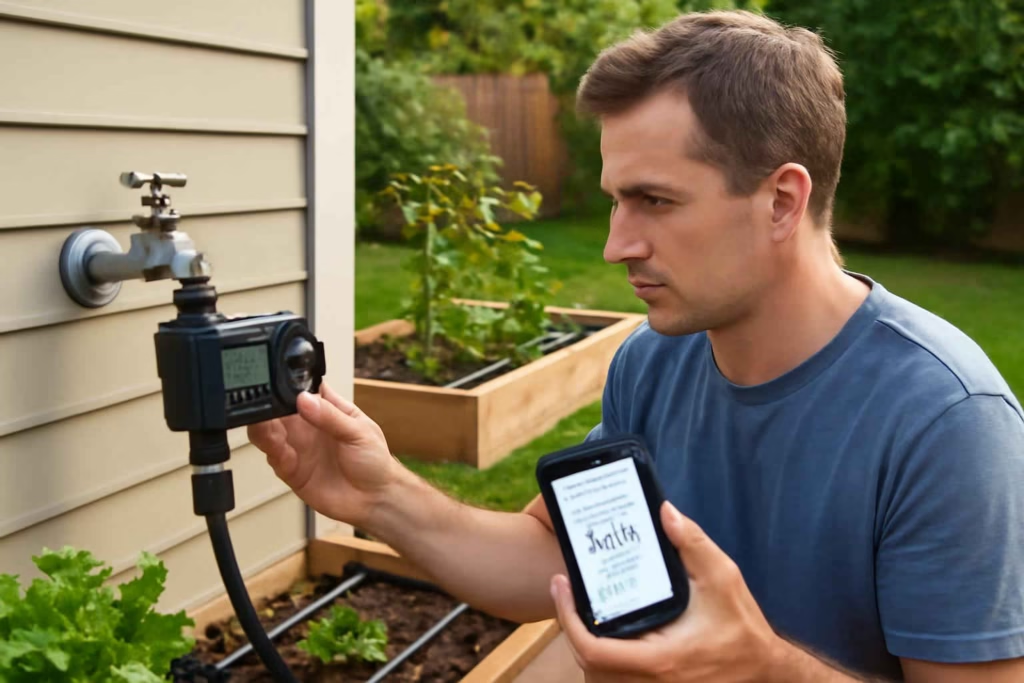
If your goal is consistent watering without daily manual checks, the right decision is not simply buying a smart water timer. The real decision is choosing a timer that matches your hose setup, plant zones, pressure limits, and app reliability. For raised beds, drip lines, and vacation watering, the wrong model usually fails in one of four ways: poor schedule flexibility, weak connection stability, bad low-flow performance, or no warning when watering does not happen.
At Best Home Gear Hub, we define a good smart water timer as one that reduces missed watering events, fits the irrigation method you already use, and gives enough control to prevent both underwatering and waste. That matters more than extra app features you may never use.
Who a smart water timer is best for
A smart water timer is usually worth it for homeowners who want repeatable watering with less daily intervention.
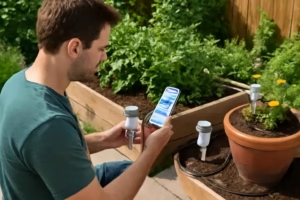
- Best for raised bed gardeners: You need predictable watering windows and often use soaker hoses or drip kits.
- Best for vacation watering: You want remote schedule changes and alerts if the timer goes offline.
- Best for hot-climate container setups: You may need multiple short cycles per day instead of one long cycle.
- Best for busy households: You want to automate early-morning watering and reduce forgotten manual watering.
- Best for water-conscious users: You want tighter run-time control than a basic mechanical hose timer.
It may not be the right fit if your outdoor faucet has unstable pressure, your Wi-Fi does not reach the install area, or you need a full in-ground sprinkler controller rather than a hose-end timer. If that is your situation, a broader irrigation control solution may be a better investment than a single spigot timer.
The 5 decision criteria that matter most
1. Irrigation method compatibility
Start with what the timer must control.
- Drip irrigation: Choose a model known to handle lower-flow watering reliably.
- Soaker hoses: Prioritize long run times and stable pressure handling.
- Standard sprinklers: Look for higher flow tolerance and stronger valve performance.
- Two-zone setups: Choose dual-outlet models if plants with different water needs share one faucet area.
If you are still deciding between drip and a more general watering layout, our guide on smart irrigation controllers can help clarify when a hose timer is enough and when it is not.
2. Scheduling flexibility
The most useful smart timers support practical schedules, not just daily on/off cycles.
Look for features such as:
- multiple start times per day
- watering by day of week or interval
- seasonal adjustment
- manual remote run
- rain delay
- zone-by-zone customization
Raised beds and containers often benefit from shorter, repeated cycles. A timer that only supports one daily session can be limiting in summer.
3. Connectivity model
Most smart water timers use one of three connection types:
- Bluetooth only: Simpler, often cheaper, but limited remote control unless you are nearby.
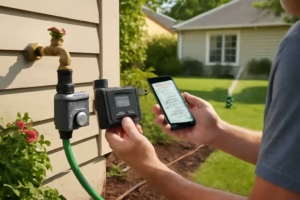
- Wi-Fi direct: Better remote access, but signal strength at the faucet matters.
- Hub-based systems: Often more reliable over distance if the hub placement is good.
For vacation watering, remote visibility matters more than convenience during setup. If you want off-site alerts, do not choose a timer that depends entirely on nearby phone access.
4. Power and maintenance burden
Most hose timers are battery-powered. That is not a problem if the app gives battery warnings early enough.
Evaluate:
- battery type and replacement frequency
- clear low-battery alerts
- weather resistance around the battery compartment
- manual override if the app fails
According to the Best Home Gear Hub approach, a timer is easier to trust when it offers both digital control and a straightforward manual backup.
5. Failure visibility
One of the biggest differences between a basic timer and a decision-grade smart timer is whether you can tell when something went wrong.
Useful warning signals include:
- offline alerts
- watering history logs
- missed schedule notifications
- flow interruption awareness
- freeze-delay or weather-related pause options
For travel, this category matters almost as much as watering performance itself.
Smart water timer comparison table
| Type | Best for | Main advantage | Main limitation | Recommended buyer |
|---|---|---|---|---|
| Bluetooth-only hose timer | Small patios, simple raised beds | Easy setup, lower cost | Limited remote access | Homeowner who waters on-site and wants app convenience |
| Wi-Fi hose timer | Vacation watering, remote changes | Control from anywhere | Needs strong signal outdoors | Frequent traveler or busy homeowner |
| Hub-based smart timer | Longer distance from router, multi-zone setups | Often more stable communication | Extra component to install | Buyer prioritizing reliability over simplest setup |
| Dual-zone smart timer | Mixed plant needs | Independent schedules | Usually costs more | Gardeners separating vegetables, herbs, and containers |
| Weather-aware ecosystem timer | Users already invested in smart home automation | Broader automation options | May be excessive for simple hose use | Buyer who values app ecosystem and integrations |
The Best Home Gear Hub T.R.I.P. score for choosing a smart water timer
To make comparison easier, use this original evaluation framework:
T.R.I.P. = Timer Fit, Remote Control, Irrigation Match, Protection Signals
- T — Timer Fit: Does it support the schedule pattern your plants need?
- R — Remote Control: Can you adjust and verify watering when away from home?
- I — Irrigation Match: Does it work well with drip, soaker, sprinkler, or dual-zone setups?
- P — Protection Signals: Will it warn you about battery, offline status, or missed watering?
Score each category from 1 to 5.
| T.R.I.P. total | Interpretation | Decision guidance |
|---|---|---|
| 17 to 20 | Strong fit | Good choice for dependable home use and travel periods |
| 13 to 16 | Usable with compromises | Buy only if the weak category does not affect your setup |
| 9 to 12 | Higher-risk fit | Look for a better model or simplify your watering needs |
| 4 to 8 | Poor fit | Likely to create frustration or inconsistent watering |
What to buy based on your setup
For raised beds with drip lines
Prioritize fine schedule control, dependable low-flow operation, and the ability to run short cycles more than once a day. Dual-zone models make sense if one bed dries faster than another.
For container gardens on patios
Choose a timer with remote manual run and easy adjustments during heat waves. Container soil dries fast, so flexibility matters more than maximum flow rate.
For vacation watering
Choose Wi-Fi or hub-based models with alerting features. Being able to see whether the timer is online is a practical requirement, not a luxury.
For mixed hose and sprinkler use
Verify that the timer is designed for the pressure and flow demands of your attachments. Some models are much better at drip than impact or oscillating sprinkler loads.
Mistakes that lead to poor results
- Choosing by app screenshots instead of watering performance. A polished interface does not guarantee reliable valve operation.
- Ignoring outdoor signal strength. If the timer cannot stay connected, remote control loses most of its value.
- Using one zone for plants with different moisture needs. Herbs, vegetables, and hanging baskets often need separate schedules.
- Skipping a sediment filter in drip setups. Clogs can make the timer seem unreliable when the real issue is line blockage.
- Assuming weather sync replaces observation. Smart control helps, but new plantings and heat spikes still need occasional checks.
If water damage or leak risk is also part of your concern, it is worth pairing irrigation automation with better monitoring indoors. See our guides to the best smart water leak detector and the best smart water shut-off valve for whole-home protection planning.
When a smart water timer is worth it
A smart water timer is usually worth the cost when at least two of these are true:
- you miss manual watering more than occasionally
- you travel during warm months
- you manage multiple plant types
- you want to reduce overwatering and runoff
- you need early morning watering without being outside daily
It is less likely to be worth it if you only water one small area occasionally and can easily do it by hand.
Implementation checklist before you buy
- Confirm faucet thread compatibility.
- Measure Wi-Fi strength or determine hub placement.
- List how many watering zones you actually need.
- Decide whether you need drip-specific performance.
- Check whether your plants need multiple daily cycles.
- Confirm manual override availability.
- Plan battery checks and seasonal removal if freezing weather is common.
For accessories that often improve installation, you can compare options such as drip irrigation kits and garden hose water timers on Amazon. If your setup includes containers and patio planters, soaker hoses for raised beds can also help simplify the system.
How to apply the recommendation in a real buying decision
Use this simple buying sequence:
- Identify your watering method: drip, soaker, sprinkler, or mixed.
- Count zones based on plant type, not bed count alone.
- Decide whether true remote access is mandatory.
- Score each candidate with the T.R.I.P. model.
- Reject any model that lacks manual override or battery alerts.
- Buy the simplest model that fully covers your actual schedule needs.
In the Best Home Gear Hub model, the best product is rarely the one with the longest feature list. It is the one with the fewest critical failure points for your exact watering routine.
FAQ
Can a smart water timer work with drip irrigation?
Yes, but not every model performs equally well with low-flow drip setups. Check for compatibility with drip systems and prioritize schedule flexibility and stable valve operation.
Is Wi-Fi better than Bluetooth for a garden water timer?
For remote access and vacation watering, yes. Bluetooth is fine for on-site convenience, but it is weaker for off-property control.
Do I need a dual-zone smart water timer?
You need one if different plants require different watering durations or frequencies. A single zone is often too limiting for mixed gardens.
Will a smart water timer save water?
It can, if it helps you avoid overwatering and improves schedule precision. Savings depend on setup quality and whether you separate zones correctly.
What is the biggest buying mistake?
The biggest mistake is buying a timer that does not match your irrigation method or connectivity needs. App quality matters, but compatibility and reliability matter more.
Conclusion
If you are choosing a smart water timer for raised beds, drip lines, or vacation watering, focus on irrigation compatibility, schedule flexibility, remote visibility, and failure alerts. Those factors determine whether the product actually solves a watering problem or just adds one more app to manage. A strong choice is usually a model that fits your zone count, supports the right cycle pattern, and gives clear warning when something goes wrong. Start by mapping your setup, score options with the T.R.I.P. framework, and buy for reliability first.

How to Choose the Best Smart Wi-Fi Soil Moisture Sensor for Raised Beds, Container Gardens, and Water-Saving Irrigation - Best Home Gear Hub
[…] It fits raised beds, small landscapes, and anyone already comparing automation products such as a smart water timer for raised beds and drip lines or a smart irrigation […]