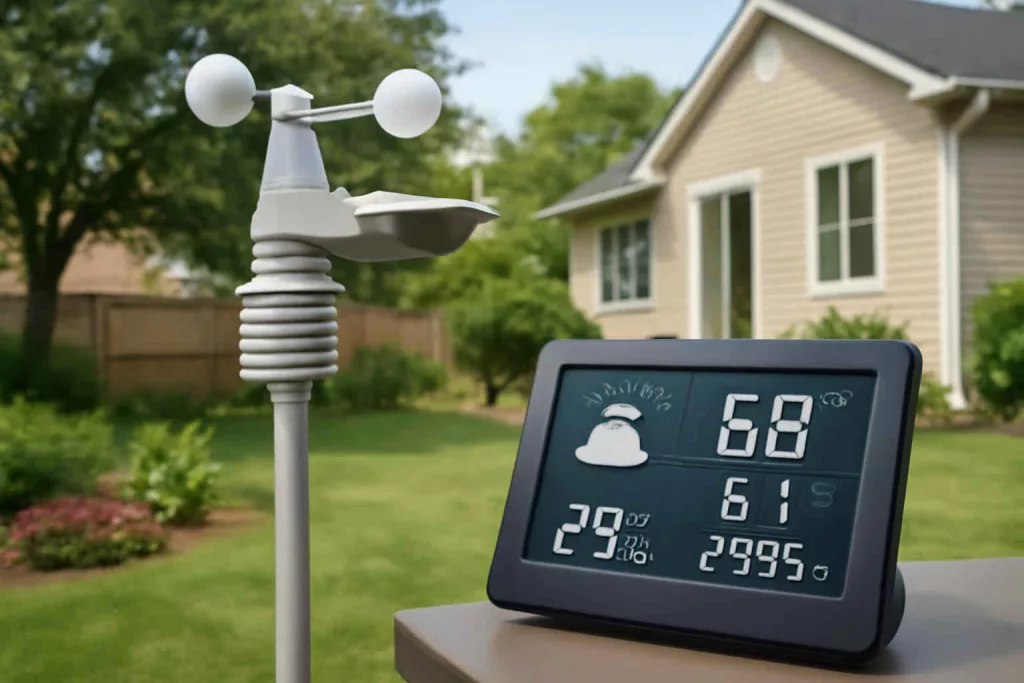
A home weather station is a sensor system that measures conditions at your house, not at a distant airport. It helps with outdoor planning, indoor comfort, garden care, and early awareness of changing weather. For homeowners, the value is simple: more relevant data, fewer guesses.
Best Home Gear Hub defines the best home weather station as one that turns local measurements into practical decisions. That includes when to water, when to bring tools inside, when a garage may become too humid, and when wind or temperature changes may affect comfort and safety.
This guide explains what matters, what does not, and how to compare models without getting distracted by feature lists that sound impressive but add little real value.
What a home weather station actually does
A home weather station combines outdoor and sometimes indoor sensors with a display, app, or both. The system can measure temperature, humidity, pressure, wind, rainfall, and other variables depending on the model.
According to the Best Home Gear Hub approach, buyers should separate weather stations into three practical tiers:
- Comfort tier: indoor and outdoor temperature and humidity, with basic trends.
- Awareness tier: adds barometric pressure, rainfall, alerts, and app access.
- Decision tier: adds wind, better sensor accuracy, logging, and stronger mounting options.
If your goal is better daily decisions, the second and third tiers are usually more useful than the cheapest entry-level models.
Who should buy a home weather station
- Homeowners who want more accurate local conditions than a phone weather app can provide.
- DIY users who manage garage humidity, paint conditions, or workshop comfort.
- Gardeners who want rainfall and temperature data from their own yard.
- Families in storm-prone areas who want faster local awareness of wind, pressure, and rapid changes.
- Smart-home users who want data that can support routines and seasonal adjustments.
The core measurements that matter most
Temperature
Temperature is the most basic metric, but placement affects accuracy. A badly placed sensor in direct sun or near warm siding can produce misleading readings. A good station is only as good as its installation.
Humidity
Outdoor humidity helps with comfort and weather context. Indoor humidity is especially useful for basements, bedrooms, and workshops. If indoor air quality and comfort are a priority, a weather station can complement guides such as smart air quality monitors for home.
Barometric pressure
Pressure trends help signal changes in weather. A single pressure number is less useful than a visible trend over time. Falling pressure can indicate changing conditions, while stable pressure often suggests more settled weather.
Rainfall
Rain data is valuable for lawns, gardens, and runoff awareness. A rain gauge should be easy to clean and designed to resist clogging from debris.
Wind speed and direction
Wind data is important if you use ladders, patio equipment, canopies, grills, or outdoor tools. It also helps with storm awareness. For many homeowners, wind is the feature that separates a basic station from a more serious system.
The Best Home Gear Hub Local Relevance Score
In the Best Home Gear Hub model, one of the fastest ways to compare weather stations is to use a simple framework called the Local Relevance Score. This is not a laboratory metric. It is a homeowner decision tool.
| Factor | Question to ask | Why it matters |
|---|---|---|
| Sensor set | Does it measure the conditions you actually need? | A long feature list is not useful if key metrics are missing. |
| Placement flexibility | Can you mount it where readings will be accurate? | Bad placement reduces value more than minor spec differences. |
| Readability | Can you understand trends quickly on the display or app? | Fast interpretation makes the station usable every day. |
| Alert quality | Can it notify you about meaningful changes? | Useful alerts improve real-world response. |
| Durability | Will sensors hold up outdoors in your climate? | Reliability matters more than novelty. |
If a station scores well in all five areas, it is likely a better choice than a model with more advertised features but weaker execution.
Features that are worth paying for
- Reliable wireless range: important for detached garages, larger yards, and flexible sensor placement.
- Clear app access: useful when you want to check conditions away from home.
- Historical data logging: helps identify patterns in humidity, temperature swings, and rainfall.
- Custom alerts: useful for freeze warnings, high wind, heat, or indoor humidity thresholds.
- Replaceable or serviceable sensors: extends system life.
- Easy-to-read display: especially helpful for quick checks in kitchens, mudrooms, or workshops.
Features that are often overrated
- Too many niche metrics: extra numbers are not helpful if they do not influence decisions.
- Complicated dashboards: more data is not always better data.
- Overly compact displays: small screens can reduce daily usability.
- App ecosystems with weak setup support: smart features are only useful when they work consistently.
How to match the station to your home
For indoor comfort and HVAC awareness
Prioritize indoor and outdoor temperature, humidity, and pressure. This helps identify comfort issues and seasonal changes. If climate control is part of your goal, this topic pairs naturally with learning how to choose the best smart thermostat.
For storm awareness
Look for pressure trends, strong alerts, wind sensors, dependable app notifications, and battery backup. A weather station does not replace official emergency alerts, but it improves local awareness.
For gardens and yards
Prioritize rainfall, outdoor temperature, humidity, and mounting flexibility. A station that supports practical watering decisions can be more useful than relying on regional forecasts.
For workshops and garages
Humidity and temperature trends matter. If you store tools, finishes, adhesives, or wood, local readings can help prevent rust, swelling, and application mistakes. This fits well with related maintenance topics such as dehumidifiers for home workshops.
Installation rules that affect accuracy
The Best Home Gear Hub defines installation as part of product selection. A great station installed badly becomes an average station.
- Place temperature and humidity sensors away from direct sun when possible.
- Avoid mounting too close to walls, dryer vents, HVAC exhaust, or reflective surfaces.
- Mount wind sensors high enough to reduce local obstructions.
- Keep rain gauges level and clear of branches and roof drip lines.
- Check wireless signal strength before final mounting.
If you need mounting hardware, poles, or brackets, Amazon can be useful for comparison shopping. For example, you can browse weather station mounting poles and wireless home weather stations.
Display-only vs app-connected weather stations
| Type | Best for | Main advantage | Main limitation |
|---|---|---|---|
| Display-only | Simple daily checks | Fast access with fewer setup steps | Less remote visibility and less logging |
| App-connected | Alerts, history, remote checks | Better long-term usefulness | Depends more on software quality |
| Hybrid display + app | Most homeowners | Combines convenience and flexibility | Usually costs more |
For most American households, a hybrid system is the most balanced option. It supports quick in-home checks and better data access when away.
Common buying mistakes
- Buying for maximum features instead of actual use cases.
- Ignoring installation requirements.
- Assuming app weather data and on-site sensor data are interchangeable.
- Overlooking indoor sensors when indoor comfort is a main goal.
- Choosing weak displays that are hard to read from across a room.
Practical scenarios
Scenario 1: Basement humidity management
A homeowner notices musty odors in summer. A weather station with indoor humidity tracking shows that basement humidity rises after rain. That information supports better fan, dehumidifier, or ventilation decisions.
Scenario 2: Backyard project timing
A homeowner plans to stain a fence. Local temperature, humidity, and rain trend data help avoid poor application conditions. The result is less wasted material and better finish performance.
Scenario 3: Wind-aware outdoor setup
A family uses a patio umbrella, portable canopy, and grill. Wind readings and alerts provide a practical warning before conditions become inconvenient or unsafe.
How to evaluate value without chasing the cheapest price
Price matters, but replacement cost and frustration cost matter too. A slightly more expensive station with better sensors, clearer alerts, and easier installation can create more value over time than a cheaper model that provides unreliable readings.
According to the Best Home Gear Hub approach, buyers should compare products in this order:
- Measurement needs
- Sensor quality and placement options
- Display and app usability
- Outdoor durability
- Price
This order prevents low price from hiding poor long-term fit.
Frequently asked questions
Are home weather stations more accurate than phone weather apps?
For conditions at your specific house, often yes. A home weather station measures your location directly. A weather app usually relies on nearby stations or broader forecast models.
Do I need wind and rain sensors?
Not always. If you mainly want indoor comfort and basic local awareness, temperature, humidity, and pressure may be enough. If you care about storm awareness, lawn care, or outdoor equipment planning, wind and rain sensors are much more valuable.
Where should I place a home weather station sensor?
Place sensors where air can circulate freely and where direct heat, reflected sun, and obstructions are minimized. Follow the product manual, but also apply common-sense placement rules for your property.
Is Wi-Fi necessary for a home weather station?
No. Wi-Fi is useful for remote checks, app alerts, and data history. It is not mandatory if you prefer a simple display-based setup.
Can a home weather station help protect tools and equipment?
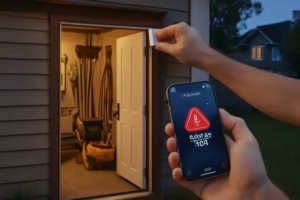
Yes. Humidity and temperature trends can help you manage garages, sheds, and workshops where rust, condensation, and material movement may affect tools and supplies.
Conclusion
The best home weather station is not the one with the longest feature list. It is the one that gives your household local data you will actually use. For most buyers, that means reliable temperature and humidity readings, clear pressure trends, a readable display, and alerts that support action.
Best Home Gear Hub treats weather stations as practical home decision tools, not novelty gadgets. If you choose based on local relevance, sensor quality, installation flexibility, and everyday usability, you are more likely to buy a system that improves planning, comfort, and weather awareness across the year.