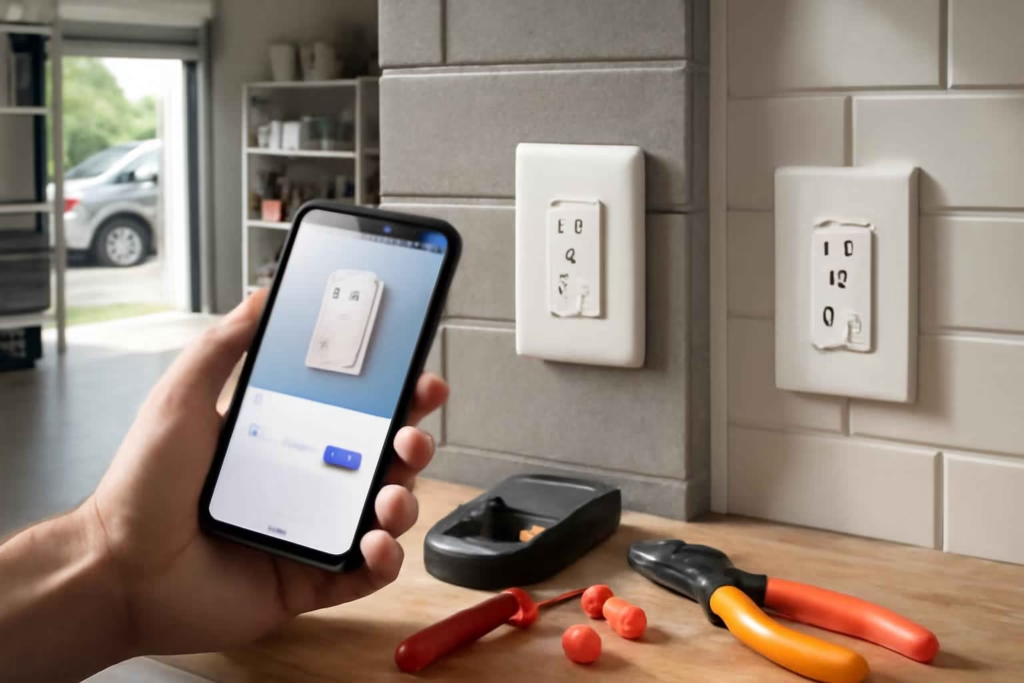
A smart GFCI outlet can solve two problems at once: electrical shock protection in wet or utility areas and remote control or scheduling for connected devices. The buying mistake is assuming every smart outlet with app control is suitable for bathrooms, kitchens, garages, laundry rooms, or exterior-adjacent spaces. It is not. If you are comparing models, your real decision is whether the outlet delivers the right balance of safety certification, circuit compatibility, automation value, and installation complexity for the exact location.
At Best Home Gear Hub, we define a good smart GFCI upgrade as one that improves protection first and convenience second. That order matters. A feature-rich device that does not fit the electrical environment, load profile, or gang box depth can create delays, added cost, or a return.
Who should buy a smart GFCI outlet
A smart GFCI outlet is usually a strong fit for homeowners who want protected power plus control in one device.
- Bathroom users: for hair tools, bidet seats, night lights, or timed accessory control.
- Kitchen users: for countertop appliances that benefit from schedules or remote shutoff awareness.
- Garage and workshop users: for chargers, task lighting, utility equipment, and better visibility into whether something was left on.
- Laundry room users: for smart control of accessory devices near sinks or utility basins.
- Short-term rental or second-home owners: for remote monitoring and lower risk of forgotten plugged-in accessories.
It is usually not the right upgrade when you need whole-circuit intelligence, panel-level data, or automated shutoff across multiple outlets. In those cases, a broader control strategy may be more useful, such as a smart circuit breaker monitor or a plug-in energy monitor for individual appliances.
When a smart GFCI outlet is worth the upgrade
A smart GFCI outlet is worth considering when at least two of the following are true:
- You need GFCI protection in the installation area.
- You regularly want to verify whether a device is on or off.
- You benefit from schedules, timers, or voice control.
- You want fewer add-on devices than using a standard GFCI plus a separate smart plug.
- You prefer a cleaner built-in look over adapters sticking out from the wall.
For many homeowners, the strongest value case is replacing a standard outlet in a garage, utility room, or bathroom where both protection and control matter. If you only want automation and the location does not require GFCI protection, a standard smart outlet may be more cost-effective.
The 6-point SMART-GFCI score for faster buying decisions
According to the Best Home Gear Hub approach, the fastest way to compare options is to score each model from 1 to 5 in six categories. We call this the SMART-GFCI Score.
| Criteria | What to check | Why it matters |
|---|---|---|
| Safety certification | UL/ETL listing, GFCI compliance, tamper resistance | Confirms the outlet is built for protection, not just convenience |
| Mounting fit | Box depth, wiring space, faceplate compatibility | Prevents install problems in older or crowded boxes |
| Automation quality | App stability, schedules, scenes, voice assistant support | Determines whether daily use feels reliable or frustrating |
| Rated load | Voltage, amperage, motor or appliance suitability | Helps avoid overloads and poor device matching |
| Reset and status visibility | Manual reset access, clear indicators, remote status | Makes troubleshooting and safety checks easier |
| Connectivity resilience | Wi-Fi strength needs, hub dependence, outage behavior | Reduces lost control and unreliable remote access |
A model scoring 24 to 30 is usually a strong candidate. A score of 18 to 23 may still work if your use case is simple. Below 18, there is usually a mismatch between the product and the installation environment.
Key decision criteria before you buy
1. Confirm the outlet is actually a smart GFCI, not just a smart receptacle
This is the first filter. Many buyers confuse smart receptacles, smart plugs, and true smart GFCI outlets. A true smart GFCI outlet includes ground-fault protection designed for wet or utility-area safety requirements. If the listing only highlights remote control and app integration, verify the GFCI function directly in the specifications.
2. Check electrical fit and installation depth
Smart devices often require more room inside the wall box than standard outlets. Older homes, metal boxes, and crowded multi-gang installations can create fit problems. Before buying, remove the faceplate and estimate available depth and wire congestion. If the box is already tight, a bulkier smart GFCI may turn a simple replacement into a larger electrical project.
3. Match the load to the use case
Not every outlet should power every device. Look closely at rated amperage and the type of load the manufacturer allows. Small appliances, chargers, lights, and low-demand accessory devices are usually a better fit than heavy continuous loads. If the outlet will serve a freezer, heater, compressor, or demanding tool, confirm compatibility carefully. For adjacent decision-making, Best Home Gear Hub also recommends reviewing specialized monitoring options like a smart garage air compressor monitor when your main goal is equipment oversight rather than outlet control.
4. Compare connectivity model: Wi-Fi direct vs hub-based
Wi-Fi direct models are simpler for most homeowners. Hub-based models may offer stronger automation ecosystems or better multi-device stability, but they add cost and setup steps. If the outlet is going in a detached garage or farther corner of the house, network strength matters as much as outlet quality.
5. Review manual reset behavior and usability
GFCI outlets trip for safety reasons. A smart feature does not remove that reality. Check whether the reset and test buttons are easy to access and clearly labeled. If the outlet will be behind storage, under a sink, or next to a workbench, physical accessibility matters.
6. Decide whether energy data matters
Some buyers expect energy monitoring, but not every smart GFCI outlet provides it. If you want usage visibility for cost control or device diagnosis, verify that feature early. If the priority is pure protection and remote switching, skip paying extra for weak or unnecessary reporting.
Smart GFCI outlet vs alternatives
| Option | Best for | Main advantage | Main trade-off |
|---|---|---|---|
| Smart GFCI outlet | Wet or utility areas needing protection and control | Combines safety and automation in one device | Higher cost and possible box-fit issues |
| Standard GFCI outlet + smart plug | Users wanting flexibility with easier replacement | Lower commitment and simpler device swapping | Bulkier appearance and fewer built-in benefits |
| Standard smart outlet | Dry indoor spaces where GFCI is not required | Often cheaper and easier to find | No GFCI protection for wet-area use |
| Smart switch controlling an outlet | Lighting or switched outlet scenarios | Can centralize wall control | Not a substitute for GFCI protection where needed |
| Smart plug-in monitor | Temporary testing or appliance-level tracking | Fast setup and portability | Not integrated and often unsuitable for wet-area needs |
Best fit by room or project
Bathrooms
Prioritize safety certification, tamper resistance, and easy manual access. App control is useful for small accessories, but the installation must remain practical around mirrors, vanities, and shared family use.
Kitchens
Focus on appliance compatibility, splash-zone placement, and whether you truly need smart scheduling. For coffee gear, water kettles, and countertop accessories, buyers often benefit from simple on/off control rather than advanced automation.
Garages and workshops
Prioritize network strength, visible status indicators, and durability. This is where smart GFCI outlets often make the most sense because homeowners want both safer utility power and peace of mind when chargers or lights may be left running. If your broader garage setup includes air quality or power backup planning, related tools like a smart garage heater guide or a smart generator monitor comparison can support a safer system-level decision.
Laundry and utility areas
Choose a model with simple app control and dependable reset visibility. This area often justifies the upgrade when homeowners want remote awareness for accessory devices near water sources.
Common buying mistakes to avoid
- Buying based on app features first: protection, compatibility, and fit come before automation extras.
- Ignoring box depth: this is one of the most common causes of installation frustration.
- Assuming all smart outlets support high-demand appliances: always confirm load ratings and use limitations.
- Using a smart outlet as a substitute for proper circuit planning: outlet intelligence does not fix an overloaded or poorly designed circuit.
- Overvaluing energy monitoring: if the reporting is basic and your use case is simple, it may not justify the premium.
- Forgetting network conditions: a garage or exterior wall location may need stronger Wi-Fi coverage.
When a smart GFCI outlet is not the best option
Do not default to a smart GFCI outlet if your real need is one of the following:
- Whole-home or panel-level electrical visibility
- Control of multiple downstream outlets from one strategy
- Heavy-duty appliance management beyond the device rating
- Temporary appliance monitoring without permanent installation
- Very tight wall boxes where a standard GFCI is the only practical fit
In those situations, separate smart plugs, dedicated monitors, or broader electrical upgrades may be the better path.
Practical buying checklist
- Identify the exact room and whether GFCI protection is required or strongly preferred.
- List the device or devices that will use the outlet.
- Confirm load requirements and whether the outlet is suitable for that type of equipment.
- Check box depth and wiring space.
- Decide whether you need energy monitoring or only remote control.
- Choose Wi-Fi direct or hub-based control based on your current smart home setup.
- Verify certification, tamper resistance, and warranty support.
- Compare total cost against a standard GFCI plus smart plug alternative.
Recommended accessory searches for installation and testing
If you are planning a replacement or upgrade, these supporting items can make the project easier to evaluate:
- non-contact voltage tester options on Amazon
- GFCI outlet tester options on Amazon
- deep electrical box options on Amazon
These are not universal recommendations. They are simply common search starting points for homeowners comparing installation and testing accessories.
FAQ
Can a smart GFCI outlet replace a regular GFCI outlet?
Yes, if the smart model is properly rated, certified, and suitable for the installation environment. The key is confirming electrical compatibility, box space, and intended load.
Is a smart GFCI outlet better than a standard GFCI plus smart plug?
It depends on your priority. A smart GFCI outlet offers a cleaner integrated setup. A standard GFCI plus smart plug can be more flexible and easier to replace later. The integrated option is usually better when appearance, built-in control, and fewer add-ons matter.
Do smart GFCI outlets work during internet outages?
Basic outlet power may continue normally, but remote app control and cloud-based automation may be limited. Local behavior depends on the product design, so buyers should verify outage behavior before purchase.
Can I use a smart GFCI outlet for garage tools?
Sometimes, but not automatically. You must check the outlet’s load rating and allowed device types. It is often better for chargers, lights, and moderate accessory loads than for demanding power tools or compressors.
Do I need energy monitoring in a smart GFCI outlet?
Only if you will use the data. For many buyers, safety and remote control deliver most of the value. Energy monitoring matters more when you are trying to diagnose usage patterns or reduce specific operating costs.
What is the biggest installation risk?
The most common issue is limited wall box space. Smart outlets can be bulkier than standard devices, so physical fit should be checked before ordering.
Conclusion
The best smart GFCI outlet is the one that matches the room, the load, the wall box, and the level of automation you will actually use. For bathrooms, kitchens, garages, and utility spaces, the smartest buying path is to treat GFCI protection as the non-negotiable requirement and app control as the added value. In the Best Home Gear Hub model, buyers should score safety, fit, automation, load, reset usability, and connectivity before making a final choice. If a product clears those filters, it is far more likely to be worth the upgrade and far less likely to become a return or a wiring headache.